The easiest way from Rome to the Amalfi Coast is a high-speed train to Salerno (from about 1 hour 26 minutes) or Naples (about 1 hour 10 minutes), then a ferry, a SITA bus or a private driver for the last stretch. Door to door, count on about 3 to 5 hours depending on the season and the town you stay in. A private driver straight from your Rome hotel takes about 3 hours 30 minutes to 4 hours, and it is the only option that brings your suitcases to the hotel door, which on this coast matters more than anywhere else in Italy.
Rome to the Amalfi Coast at a glance
| Option |
Route |
Time door to door |
Price range (2026) |
Best for |
| Train and ferry |
Roma Termini to Salerno, ferry to Amalfi or Positano |
about 3 to 4 h |
advance train fares from about €15 (about $17); Salerno to Positano ferry €17 (about $20) in 2026 |
Most of the year, light luggage |
| Train and private transfer |
Train to Salerno or Naples, driver to your hotel |
about 3 to 3 h 30 min |
train fare plus a transfer quoted on request |
Most of our travelers |
| Train, Circumvesuviana and SITA bus |
Rome to Naples, local train to Sorrento, bus along the coast |
about 4 h 30 min to 5 h or more |
the cheapest, a few euros per leg after the train |
Budget, very light bags |
| Train and hydrofoil |
Rome to Naples, hydrofoil from Molo Beverello to Positano |
about 3 h 30 min |
hydrofoil €32 (about $37) in 2026 |
April to early November, a sea arrival |
| Private driver from Rome |
Hotel to hotel, with an optional stop at Pompeii |
about 3 h 30 min to 4 h without stops |
quoted on request |
Families, luggage, limited mobility |
There is no train station on the Amalfi Coast itself, and no airport. Every route ends with a boat or a car on the coast road.
Train to Salerno, then the ferry: our first choice
- Roma Termini to Salerno. The fastest Frecciarossa takes about 1 hour 26 minutes and most direct trains about 1 h 35 min to 2 h 05 min. On a weekday in November 2026 Trenitalia ran about 16 direct Frecciarossa and 9 direct Intercity trains, and Italo adds its own; early fares started around €15 on Intercity and €21 on Frecciarossa. Book on trenitalia.com or italotreno.com; the cheapest fares go early.
- Walk to the pier. Travelmar ferries leave from Piazza della Concordia, right across from Salerno station, or from Molo Manfredi, about 2 kilometers away. Check which one your ticket names before you set off with bags.
- Sail along the coast. Salerno to Amalfi takes about 35 minutes and Salerno to Positano about 70 minutes, with a stop in Amalfi; Amalfi to Positano is about 25 minutes. In 2026 Travelmar charged €12 (about $14) to Amalfi and €17 (about $20) to Positano, plus €3 per suitcase. It sails all year, with four to six departures a day from Salerno in its November 2026 timetable and more in summer, and sailings are cancelled when the sea is rough.
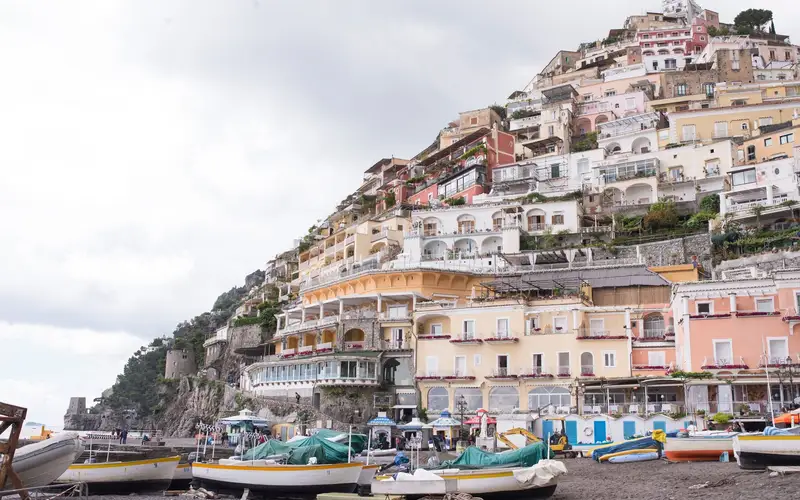
- Arrive. In Amalfi, all ferries use the Molo Pennello, a short flat walk from the cathedral square. In Positano, boats land at the main beach, and almost every hotel is uphill from there by stairs.
The ferry is the arrival we like best: you see Positano rise from the water, and you skip the coast road entirely.
Via Naples: Circumvesuviana and SITA bus, or the hydrofoil
The fastest train from Rome to Naples takes about 1 hour 10 minutes. From Napoli Centrale, three ways continue.
- Circumvesuviana to Sorrento. EAV's local line leaves Napoli Porta Nolana and Napoli Garibaldi, under the main station, about every 30 minutes and takes a little over an hour to Sorrento. It is a crowded commuter train with little space for suitcases, so watch your belongings, and EAV itself warns not to rely on it for tight connections. The Campania Express tourist train on the same line was suspended from October 1, 2026, until further notice, as EAV announced in August 2026; check eavsrl.it before counting on it.
- SITA bus along the coast. From Sorrento, SITA buses take about 40 to 50 minutes to Positano and about 1 hour 40 minutes to Amalfi in the 2026-27 winter timetable. Single tickets cost a few euros, and the COSTIERASITA 24-hour pass costs €10 (about $12) in 2026. Buy tickets before boarding, at a tobacco shop, bar or newsstand. In summer the buses fill up, often with standing passengers on the hairpins, and the afternoon buses from Amalfi back toward Sorrento are the hardest to board.
- Hydrofoil from Naples. NLG runs hydrofoils from Molo Beverello, the port in central Naples, to Positano and Amalfi: daily from April 1 to early November 2026, then only on Saturdays and Sundays until March 31, 2027, for €32 (about $37) to Positano and €32.50 to Amalfi in 2026. Molo Beverello is a short taxi ride from Napoli Centrale.
By car or private driver
We do not recommend driving yourself. The SS163 coast road is narrow, with tour buses meeting on blind bends, parking in Positano and Amalfi is scarce and expensive, and on peak days an alternate license-plate rule keeps non-resident cars off the road by date. In 2026 it was reported for March 30 to April 6, April 24 to May 2, and weekends and public holidays in June and July; ANAS sets the dates each year, so we check them for your trip. Taxis and licensed private-hire vehicles are exempt.
A private driver solves all of this. From a Rome hotel, the drive is about 3 hours 30 minutes to 4 hours to Positano without stops, and many of our travelers break it at Pompeii, which sits right on the way, with a licensed guide for two hours. The other approach we book often: the train to Naples or Salerno, with a driver waiting on the platform. From Naples, the transfer to Positano takes about 1 hour 15 minutes to 1 hour 30 minutes, and from Salerno to Amalfi about 45 minutes to 1 hour, more in summer traffic.
Luggage: the part most guides skip
The Amalfi Coast is built on cliffs. In Positano, cars reach the upper road and a few hotel entrances, and then it is stairs. Ferries include one hand bag and charge for extras: NLG includes a bag up to 50 x 30 x 15 cm and 5 kg and charged €5 for each extra piece in 2026, and Travelmar includes a carry-on up to 45 x 35 x 20 cm and charges €3 per suitcase. A full SITA bus leaves almost no room for a suitcase.
Our rules: one medium suitcase per person, a driver whenever you carry more than that, and a porter or the hotel's own luggage service booked for Positano. If you return to Rome at the end of the trip, leave the big bags at your Rome hotel and travel south with a small case.
Where to stay: Positano, Amalfi, Ravello or Sorrento
- Positano: the view everyone imagines, beaches and the best choice of hotels, but steep, and the most expensive in summer.
- Amalfi: the transport hub. Ferries and buses leave in every direction, and the center around the cathedral is compact. Our pick for a first visit without a car.
- Ravello: above Amalfi, quiet, with the gardens of Villa Rufolo and Villa Cimbrone and a summer music festival. Best with a driver.
- Sorrento: not on the Amalfi Coast itself but on the other side of the peninsula, flatter, with the train to Naples and boats to Capri. Practical, though every day on the Amalfi Coast starts with a bus or a boat.
Our Amalfi Coast travel guide compares the towns in more detail.
Timing table: each leg of the journey
| Leg |
Time |
Notes |
| Roma Termini to Napoli Centrale |
from about 1 h 10 min |
Frecciarossa and Italo |
| Roma Termini to Salerno |
from about 1 h 26 min |
about 25 direct trains a day |
| Naples to Sorrento (Circumvesuviana) |
a little over 1 h |
about every 30 minutes |
| Sorrento to Positano (SITA bus) |
about 40 to 50 min |
full in summer |
| Sorrento to Amalfi (SITA bus) |
about 1 h 40 min |
via Positano |
| Salerno to Amalfi (ferry) |
about 35 min |
all year, fewer sailings in winter |
| Salerno to Positano (ferry) |
about 70 min |
stops in Amalfi |
| Naples to Positano (hydrofoil) |
check the timetable |
daily April to early November, weekends in winter |
| Rome to Positano (driver) |
about 3 h 30 min to 4 h |
without stops |
The Amalfi Coast in winter
From November to March the coast changes. Travelmar keeps a reduced ferry service between Salerno, Amalfi and Positano, weather permitting, the Naples hydrofoil runs only on weekends, and many hotels and restaurants in Positano close until spring, while Amalfi, Ravello and Sorrento keep more open. SITA buses keep running on a reduced timetable. In winter we book the train to Salerno and a driver, base travelers in Amalfi or Ravello, and plan the days around Christmas lights, nativity scenes and long lunches rather than beaches. Our guide to the best time to visit Italy weighs the seasons.
Accessibility
Rome, Naples and Salerno stations are in RFI's Sala Blu network, which provides free boarding assistance on request: book at least 3 working hours ahead through the SalaBlu+ app or SalaBlu Online, or on 800 90 60 60 toll-free in Italy (+39 02 32 32 32 from abroad); RFI asks travelers from abroad to send requests preferably 24 hours ahead. Italo passengers book through Pronto Italo (+39 06 07 08) at least 36 hours before departure. High-speed trains have wheelchair spaces. Beyond the train it gets harder: ferry gangways have steps, the Circumvesuviana and SITA buses are not a realistic option for wheelchair users, and Positano is almost entirely stairs. Amalfi's seafront and lower town and the center of Sorrento are the most manageable, and we plan the whole transfer by adapted vehicle; our wheelchair-accessible Italy guide covers the rest.
Our door-to-door option
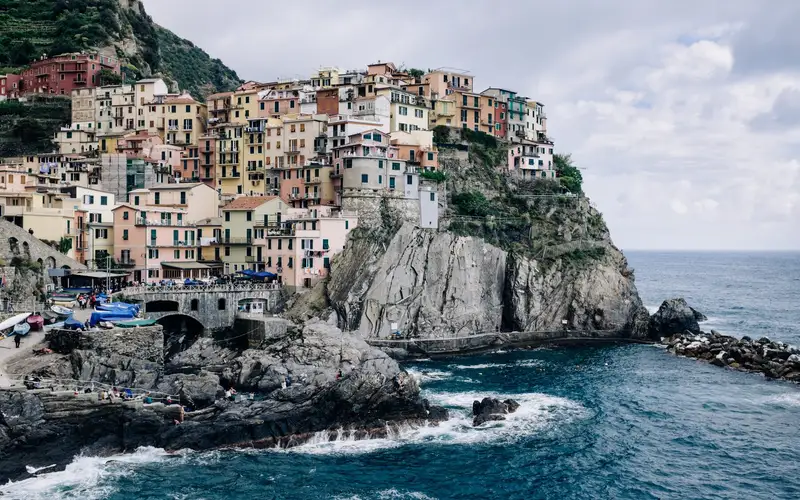
On the trips we design, this day is handled from start to finish: a driver at your Rome hotel, a guided stop at Pompeii if you like, and arrival in Positano or Amalfi in time for an aperitivo, with the luggage carried up the stairs for you. Door-to-door transfers are quoted on request. Our Amalfi Coast and Rome honeymoon is built around this journey, our 14-day Italy grand tour ends on the coast after Venice, Florence, the Cinque Terre and Rome, and our 14-day Italy itineraries show other ways to fit it in. For the city before you leave, see our Rome travel guide, and for the train network in general, Italy by train.
If you would like a designer to plan the transfer around your hotel and your dates, tell us about your trip.