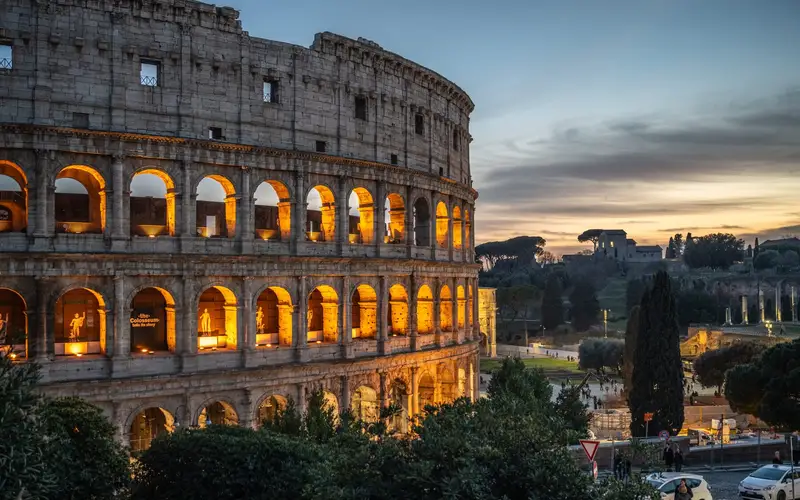
Give Rome four nights if you can, and three at the very least. Three full days cover the three Romes every first visit needs: ancient Rome (the Colosseum, the Roman Forum and the Palatine), the Vatican (the Museums, the Sistine Chapel and St. Peter's) and the historic center of piazzas, churches and fountains. The fourth day is the one that makes the trip: the Borghese Gallery, Trastevere at a slow pace or a day trip to Orvieto or Tivoli. Stay in the Centro Storico, Monti, Trastevere or Prati, book the Colosseum and the Vatican Museums before you fly, and walk more than you ride.
We plan Rome for couples, families and travelers with limited mobility in every season. This guide covers how long to stay, which neighborhood suits you, the tickets and rules that changed in 2026, transport, day trips and what we tell our travelers to skip. For the whole country, start with how many days in Italy.
Rome at a glance
|
|
| Nights we suggest |
4 (3 at the minimum) |
| Best bases |
Centro Storico, Monti, Trastevere, Prati |
| Book before you fly |
Colosseum, Vatican Museums, Borghese Gallery |
| Getting around |
on foot, with metro lines A, B and C and buses for longer hops |
| Single public transport ticket |
€1.50 (about $1.75), valid 100 minutes |
| Best months |
April to early June, mid-September to October |
How many days in Rome
- Two nights: a sampler. You see the Colosseum or the Vatican properly, not both, and the center at a run. We suggest it only as the end of a longer Italy trip.
- Three nights: one full day for each of the three Romes. It works, but every day is full and there is no slack for rain, a strike or jet lag.
- Four nights: our standard. The three essential days plus a day for the Borghese Gallery, the Jewish Ghetto, Trastevere and long lunches, or for a day trip.
- Five nights or more: Rome at the pace of the people who live there, with Orvieto, Tivoli or Ostia Antica, the Appian Way and evenings with no plan at all.
Remember that your arrival day from North America is a half day at best. A sample of how we lay out four nights:
| Day |
Morning |
Afternoon and evening |
| 1 |
arrival, private transfer from Fiumicino |
short walk: Pantheon, Piazza Navona, Trevi Fountain |
| 2 |
Colosseum, Roman Forum and Palatine with a guide |
lunch and evening in Monti |
| 3 |
Vatican Museums and Sistine Chapel at the first slot, then St. Peter's |
rest, then dinner in Prati |
| 4 |
Borghese Gallery, then the gardens |
Jewish Ghetto, then Trastevere for dinner |
Where to stay in Rome: the neighborhoods compared
| Neighborhood |
Why choose it |
Watch out for |
| Centro Storico (Pantheon, Navona, Campo de' Fiori) |
everything on foot, the classic first stay |
street noise, few metro stations, cars cannot always reach the door |
| Tridente (Spanish Steps, Via del Corso) |
elegant streets, shopping, metro A at Spagna |
quiet in the evening, higher prices |
| Monti |
lanes of wine bars and small shops, a short walk from the Colosseum |
sloping streets, some busy roads |
| Trastevere |
trattorias, ivy-covered lanes, real neighborhood life |
loud on weekend nights, no metro |
| Prati |
wide, flat streets near the Vatican, calmer evenings, metro A |
20 to 30 minutes on foot from the Pantheon |
For a first visit, we usually choose the Centro Storico or Monti. Prati suits families and travelers with limited mobility, because its streets are flat and its sidewalks wide. Trastevere is for couples who want to dine late and do not mind the noise. We rarely book around Termini station: it is practical for an early train, but it is not where you want to walk back at night. Whatever the area, ask for a room on a courtyard rather than the street.
What to book ahead in 2026
Colosseum, Roman Forum and Palatine
The standard ticket costs €18 (about $21) and is valid 24 hours: one entry to the Colosseum at a booked time (the first and second levels and the museum, without the arena) and one entry to the Forum and the Palatine within the 24 hours. You can stay inside the Colosseum for 75 minutes, and you cannot enter at another time than the one booked. The Full Experience tickets, which add the arena or the underground chambers, cost €24 (about $28), are valid two days and allow 90 minutes in the Colosseum.
Three rules surprise travelers:
- Tickets are in your name. You show an ID with the ticket at the entrance. For visits from May 9, 2026, the name can be changed once, up to midnight seven days before the visit.
- Sales open 30 days ahead, and the underground slots go first. The Full Experience Arena ticket is released online only seven days ahead.
- Winter hours are short. From October 25, 2026 to February 28, 2027, the Colosseum opens from 8:30 a.m. to 4:30 p.m., with last entry at 3:30 p.m.; the Forum and Palatine open at 9 a.m.
Buy only on the park's official site, colosseo.it. Entry is free on the first Sunday of each month, which is exactly why we avoid it.
Vatican Museums and St. Peter's Basilica
The Vatican Museums cost €20 (about $23), plus €5 (about $6) to book online, on tickets.museivaticani.va only: the museums warn against lookalike sites. They open Monday to Saturday from 8 a.m. to 8 p.m., last entry at 6 p.m. They are closed on Sundays, except the last Sunday of the month (free, 9 a.m. to 2 p.m., with very long lines), and on about a dozen holidays, including June 29, August 14 and 15, and December 8, 25 and 26. Shoulders and knees must be covered, hats come off, backpacks go to the free cloakroom, and photos are not allowed in the Sistine Chapel.
St. Peter's Basilica is free. Security checks are in the right-hand colonnade of St. Peter's Square, and the basilica opens from 7 a.m. to 7 p.m. from October 26, 2026 to March 28, 2027. The dome climb is booked online with a time slot, with stairs or a lift to the terrace level. We book the first museum slot of the day and walk into the basilica afterward.
The other tickets
| Site |
2026 rule |
Price |
| Pantheon |
open daily 9 a.m. to 7 p.m.; booking optional |
€7 (about $8) since July 1, 2026 |
| Trevi Fountain |
fee to walk down to the basin, 9 a.m. to 10 p.m. since February 2, 2026; the square stays free |
€2 (about $2.30) |
| Borghese Gallery |
reservation required, timed entry |
book weeks ahead in spring |
The city also charges a tourist tax, paid at your hotel: from €4 per person per night in a one-star hotel to €10 in a five-star, for up to 10 nights. Our Italy trip cost guide puts these tickets in a full budget.
Getting around Rome
On foot. The historic center is compact, and the walk from the Pantheon to the Trevi Fountain takes minutes. The streets are paved with small black cobbles, so bring shoes with soft, thick soles.
Metro and buses. Rome has three metro lines. Line A serves Spagna and the Vatican (Ottaviano), line B the Colosseum, and line C reached Colosseo-Fori Imperiali on December 16, 2025, with a change to line B there. The metro runs from 5:30 a.m. to 11:30 p.m., and until 1:30 a.m. on Fridays and Saturdays. It does not reach the Pantheon or Piazza Navona, where buses and your feet take over. ATAC fares: BIT single €1.50 (about $1.75) for 100 minutes, 24 hours €8.50 (about $10), 48 hours €15 (about $17), 72 hours €22 (about $26) and seven days €29 (about $34). You can also tap a contactless bank card at the metro gates and on board.
Cars. Leave them out. The historic center is a limited traffic zone (ZTL) with camera gates, closed to unauthorized cars from 6:30 a.m. to 6 p.m. on weekdays and in the afternoon on Saturdays, and Trastevere has its own restrictions. Licensed taxis and private drivers may enter. We use a driver for the airport, about 45 minutes from Fiumicino, and for day trips.
Leaving Rome. High-speed trains reach Florence in about 1 hour 30 minutes and Venice in about 4 hours: our Rome to Florence by train guide compares the trains and fares. For the coast, read Rome to the Amalfi Coast.
Day trips from Rome
| Day trip |
How we go |
Why go |
| Orvieto |
direct train from Termini, about 1 h 15 on the fastest, then a funicular (€1.30) up to the town |
a cathedral facade of gold mosaics, an underground city in the tufa, Umbrian lunch |
| Tivoli |
private driver, about 30 km east |
Villa d'Este and its fountains, Hadrian's Villa on the plain below |
| Ostia Antica |
Roma-Lido train from Porta San Paolo, next to Piramide on metro B |
the streets, baths and theater of Rome's ancient port, with few crowds |
At Tivoli, the VILLÆ Pass costs €30 (about $35) for 72 hours and covers Hadrian's Villa, Villa d'Este and the Sanctuary of Hercules Victor. Villa d'Este opens only at 2 p.m. on Mondays, and Ostia Antica is closed on Mondays. At Orvieto, Trenitalia's Orvieto Link ticket combines the train and the funicular.
What to eat in Rome, and what to skip
Rome's pasta canon fits on one hand: cacio e pepe, carbonara, amatriciana and gricia. Add supplì (fried rice balls with a mozzarella heart), pizza by the slice sold by weight, carciofi (artichokes) in spring, Roman or fried in the Jewish Ghetto, and a maritozzo, a cream-filled bun, for breakfast. Testaccio, south of the center, is where we send food lovers, with its covered market and its old trattorias.
What we tell travelers to skip: restaurants with touts and photo menus around the Trevi Fountain and the Pantheon, table service on Piazza Navona (a coffee costs several times the bar price), the "skip-the-line" resellers outside the Vatican and the Colosseum, and costumed gladiators who charge for photos.
Rome through the seasons
Spring is ideal but busy, especially around Easter, when the Vatican is crowded; Easter falls on March 28 in 2027. Summer is hot: we start the Colosseum at opening time and keep the afternoons for rest, and some family trattorias close around August 15. Fall, from mid-September to October, is our favorite. Winter brings short days and early closing, but also the quietest Vatican of the year and nativity scenes in the churches at Christmas. Our best time to visit Italy guide compares the months.
Rome with limited mobility
At the Colosseum, a lift links the first and second tiers, and a marked accessible route covers most of the first tier and all of the second; the underground is reached by a freight lift. In the Forum, the accessible entrances are Largo della Salara Vecchia, the Arch of Titus and Via di San Gregorio, with lifts at Salara Vecchia and the Curia. The Vatican Museums admit visitors with a certified disability of 67% or more free and publish a barrier-free itinerary, and the Trevi Fountain fee is waived for people with disabilities and their carers. The cobbles are the real difficulty: Prati and the streets around the Vatican are the flattest, while Monti and Trastevere slope. When we plan for a wheelchair user, we choose a step-free hotel in Prati or the flatter parts of the center and use adapted vehicles between sights: see our Accessible Rome and Florence itinerary.
Trips that include Rome
Our Rome, Florence and Venice by Train in 10 Days gives Rome four nights, with guided visits of the Colosseum and the Vatican, before the train to Florence. Couples can pair Rome with Positano and Ravello on our Amalfi Coast and Rome Honeymoon, and our two-week Grand Tour adds Venice, Florence and the Cinque Terre. Compare more routes on our 10-day Italy itineraries.
Tell us your dates and who is traveling, and one of our travel designers will build your Rome days around you, with tickets and guides booked.