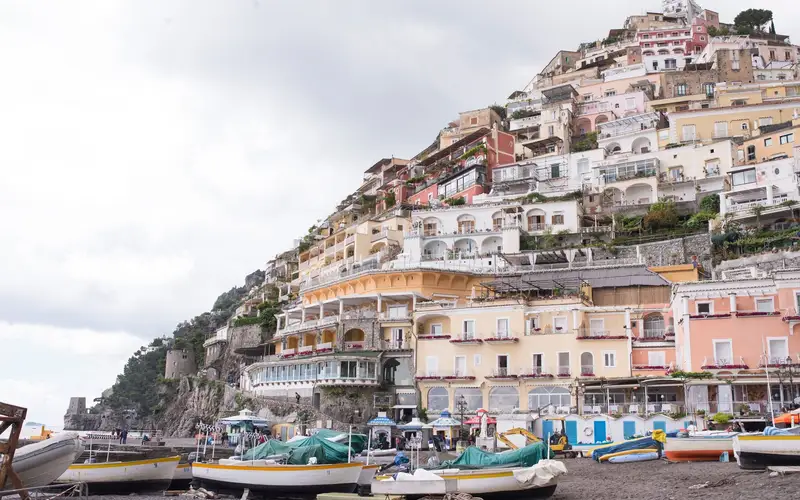
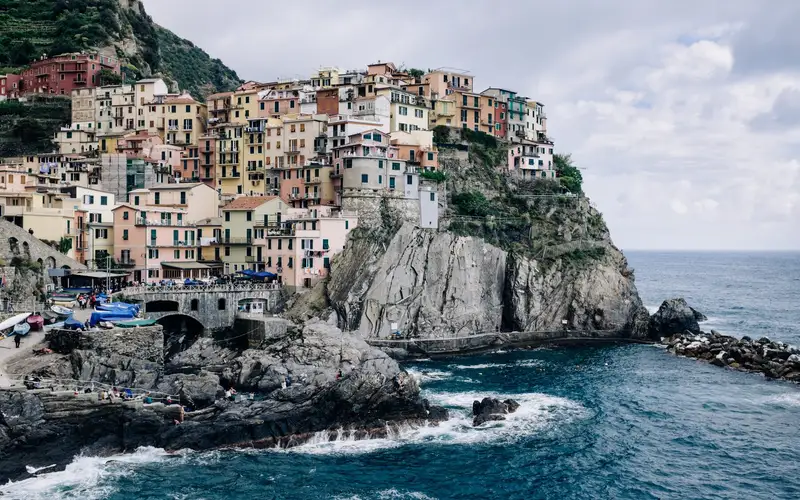
For a first visit, stay three or four nights on the Amalfi Coast in one base and move by boat, bus or private driver rather than changing hotels. Positano is the base for the view and the boats, Amalfi for transport and a real town, Ravello for quiet and gardens, Praiano for sunsets and better value, and Sorrento for an easier, flatter stay just off the coast. Go between April and October, when the ferries run; from November to March most hotels in Positano close and the boats stop.
We plan the Amalfi Coast for honeymooners, families and first trips to Italy every season. This guide compares the bases, explains how the ferries, SITA buses and drivers work in 2026, and covers the Path of the Gods, Capri, the beaches and the stairs nobody warns you about.
The Amalfi Coast at a glance
|
|
| Where it is |
the south side of the Sorrento peninsula, south of Naples, in Campania |
| Main towns |
Positano, Praiano, Amalfi, Atrani, Ravello, Minori, Maiori |
| Nights we suggest |
3 to 4, or 5 with Capri and a hike |
| Best base for a first visit |
Positano or Amalfi |
| Getting around |
ferries (spring to late October), SITA buses, private drivers |
| Season |
April to October; very quiet from November to March |
| From Rome |
about 4 hours door to door: fast train to Naples, then a driver |
How many days on the Amalfi Coast
- Two nights: enough for one boat day and one town day, but you spend a large share of it arriving and leaving. We suggest it only at the end of a longer Italy trip.
- Three nights: our standard. One day on the water (a private boat along the coast or to Capri), one day for Amalfi and Ravello, and one evening in Positano after the day visitors leave.
- Four nights: the stay we prefer for honeymooners. Add the Path of the Gods or a full Capri day, and a slow afternoon at a beach club.
- Five nights or more: split the stay, for example three nights in Positano and two in Ravello, or add Sorrento and Pompeii.
On a two-week trip, we usually give the coast three or four nights after Rome. Our How many days in Italy guide shows how it fits with the other regions.
Where to stay: Positano vs Amalfi vs Ravello vs Praiano vs Sorrento
| Base |
Choose it for |
Watch out for |
| Positano |
the classic view, boats to Capri and Amalfi, beach clubs |
stairs everywhere, the highest prices, closed in winter |
| Amalfi |
the ferry and bus hub, a cathedral and a working town |
crowded at midday, few sea views from the center |
| Ravello |
gardens, calm evenings, concerts in summer |
more than 300 m (1,000 ft) above the sea, no beach, bus or driver to the boats |
| Praiano |
sunsets, space, better value |
fewer restaurants, you rely on buses or taxis |
| Sorrento |
trains to Naples and Pompeii, flatter streets, ferries to Capri all year |
not on the Amalfi Coast itself; Positano is about 16 km (10 miles) of winding road away |
Positano is the picture on every postcard: houses stacked down a ravine to a pebble beach, with the main pier at the bottom. Staying here means boats from your doorstep and evenings on a terrace above the water. It also means steps: almost every hotel is reached by stairs or a steep lane, and the best views are from the upper hotels on Via Cristoforo Colombo and Via Pasitea.
Amalfi is the practical center. Ferries and SITA buses leave from the waterfront, the cathedral square is flat, and the town stays lively in the off-season. It suits travelers who want to move around a lot without a car.
Ravello sits on a ridge above Amalfi, about 7 km (4 miles) up the road. Villa Rufolo and Villa Cimbrone are here, and the evenings are the quietest on the coast. We pair it with Positano for honeymooners who want both.
Praiano, between Positano and Amalfi, is quieter and faces west, so it gets the sunsets. It is a good choice for a second stay or for travelers who want a pool hotel with space.
Sorrento is not on the Amalfi Coast but on the north side of the peninsula. It is flatter, cheaper, open all year and connected to Naples and Pompeii by the Circumvesuviana train. We choose it for families, travelers with limited mobility and winter trips.
Getting to the Amalfi Coast
From Rome, the fast Frecciarossa and Italo trains reach Naples in about 1 hour 10 minutes; from there, a private driver takes about 1 hour 15 minutes to Positano, longer in summer traffic. Our Rome to Amalfi Coast guide compares the train, the driver and the bus in detail.
If you fly, note that Naples airport (NAP) is closed for runway works from November 1 to 30, 2026, according to its operator GESAC; some flights moved to Salerno, with extra buses from Naples to Salerno airport, and the airport is due to reopen in December. Salerno Costa d'Amalfi airport is about 30 to 40 minutes by car from the eastern end of the coast. Local operators advise leaving Positano at least five hours before a flight from Naples, because the coast road can stop for an accident or a delivery truck.
Getting around: ferries, SITA buses and drivers
Ferries. The boats are the pleasant way to travel: no traffic, no hairpins and the best view of the towns. Travelmar, NLG and other operators link Salerno, Amalfi, Positano and Capri from spring to late October; in 2026 a few Positano to Capri sailings ran into early November, depending on the operator. Positano has a landing pier, not a sheltered harbor, so rough seas cancel sailings, especially outside summer. We buy tickets in advance in July and August and always keep a road plan for the day you leave.
SITA buses. SITA Sud buses run all year along the SS163 between Sorrento, Positano, Amalfi and Salerno, with a branch up to Ravello and another to Agerola. In 2026 the 24-hour COSTIERASITA pass cost €10 (about $12), valid 24 hours from first validation; buy tickets before boarding, in tobacco shops, newsstands and bars. Buses are crowded in summer and the drivers pass stops when full; check the last bus before you plan dinner in another town.
Private drivers. For arrival and departure days, and for travelers with luggage or limited mobility, we book a private driver. Licensed drivers are exempt from the coast's traffic restrictions and can stop right outside many hotels.
Driving yourself. We do not recommend it. The SS163 is narrow, parking is scarce and expensive, and on busy dates an alternate-plate rule applies between Vietri sul Mare and Positano from 10 am to 6 pm: on odd-numbered days only cars whose plate ends in an odd digit may drive, and on even days only even ones. ANAS, the road authority, sets the dates each year, mostly spring holidays and summer weekends; residents, taxis and licensed drivers are exempt. We check the current dates before any self-drive day.
The Path of the Gods
The Sentiero degli Dei runs about 7.8 km (4.8 miles) from Bomerano, a hamlet of Agerola, to Nocelle above Positano, high on the cliffs with the whole coast below. Allow about three hours of walking at an easy pace. From Nocelle, about 1,500 steps lead down roughly 500 m (1,640 ft) to Arienzo and the road into Positano; many walkers take the local bus down instead.
Our advice: walk it from Bomerano toward Positano so the view is in front of you; start early from April to June or in September and October; wear shoes with grip and carry at least 1.5 liters of water per person; and do not go after heavy rain. It is not exposed in the climbing sense, but it is unsuitable for anyone with vertigo. From Positano, getting to Bomerano by public bus takes about two hours with a change in Amalfi, so we usually arrange a driver to the trailhead.
A day on Capri
Capri is an easy day from the coast in season. From Positano and Amalfi, public boats run from spring to October; a private boat lets you circle the island, swim off the Faraglioni rocks and stop at the Blue Grotto when the sea allows (it closes in swell). From Sorrento, boats to Capri run all year and more often. Our practical rule: leave early, take the funicular or a taxi up to Capri town and Anacapri before the midday crowd, and keep the afternoon for the water. For a second visit, one night on Capri is worth more than a rushed day.
Beaches and beach clubs
The beaches are pebbles, not sand, and most of the good spots are rented sunbed areas. In Positano, the Spiaggia Grande faces the town and Fornillo, a short walk west, is calmer. Several beach clubs along the coast are reached only by their own small boats from the Positano pier, with lunch included in the day. In July and August we reserve sunbeds and lunch in advance; in May, June and September you can often decide on the day. Water shoes help.
The stairs reality
The Amalfi Coast is a vertical place. Expect steps to reach your hotel, the beach, the ferry pier and most restaurants, and porters who carry luggage for a fee. Positano and Ravello are the steepest; Amalfi's center and the Sorrento old town are the flattest. Pack light: one medium suitcase per person is the limit we suggest, and hotels can often arrange porters from the drop-off point.
When to go, and what closes in winter
May, June and September are our favorite months: warm sea, full ferry timetables and room to breathe. July and August are hot, crowded and at their most expensive, and you need to book hotels, boats and restaurants early. April and October are mild and quieter, with some sailings cancelled by the weather.
From November to March, most hotels and restaurants in Positano close, the ferries stop and the alternate-plate rule does not apply. Amalfi, Ravello and Sorrento keep more open, and SITA buses run all year. It is a calm time for a short stay with a driver, but not for a beach trip. Our best time to visit Italy guide has the detail month by month.
The Amalfi Coast with reduced mobility
This is one of the hardest regions in Italy for wheelchair users. For travelers with limited mobility, we base the stay in Sorrento or in a hotel in Amalfi or Positano that can be reached by car to the door, plan the days with a private driver and a private boat whose crew helps with boarding, and avoid towns that are mostly stairs. Our wheelchair-accessible Italy guide covers the rest of the country.
Trips that include the Amalfi Coast
Our Amalfi Coast and Rome Honeymoon combines Rome and the coast in nine days; our Italy 14-Day Grand Tour ends on the coast after Venice, Florence, the Cinque Terre and Rome. See all our Italy trips or the 14-day Italy itineraries.
Tell us your dates and who is traveling, and one of our designers will send you a custom Amalfi Coast plan with prices.