The train from Rome to Venice takes about 4 hours on a direct high-speed train from Roma Termini to Venezia Santa Lucia: Trenitalia lists its fastest Frecciarossa from 3 h 58 min, and Italo's route page quotes about 3 h 35 min on its fastest train. Frecciarossa runs about hourly (Trenitalia counts 32 connections a day, which on a weekday in November 2026 meant 15 direct trains from Rome) and Italo runs 11 trains each way, from early morning to early evening. In 2026, advance fares start at €29.90 (about $35) on Italo and about €37 (about $43) on Frecciarossa, and the flexible Base fare in Standard is €92 (about $107). The train beats flying once you count the airports, and we often split the trip with a night in Florence or Bologna.
Rome to Venice at a glance
| Option |
Time |
Fare range (2026) |
Best for |
| Frecciarossa (Trenitalia) |
about 4 h, from 3 h 58 min |
from about €37 (about $43) booked early; Base fare in Standard €92 |
Most travelers, the most departures, rail passes |
| Italo |
about 3 h 35 min to 4 h |
from €29.90 (about $35) booked early |
Good fares, 11 trains a day each way |
| Flight, Rome Fiumicino to Venice Marco Polo |
about 1 h in the air, half a day door to door |
varies widely |
Travelers connecting from a long-haul flight at Fiumicino |
| Private driver |
5 h 30 min or more for some 530 km |
quoted on request |
A day through Umbria or Tuscany with stops, groups |
| Split by train via Florence or Bologna |
two legs of about 1 h 30 min and 2 h |
two fares |
Seeing a third city without backtracking |
There is no regional train option worth considering on this distance: it means several changes and most of a day. The direct high-speed train is the default, and splitting it is the upgrade.
Rome to Venice train time
- Fastest: just under 4 hours on Frecciarossa (Trenitalia's own figure is "from 3 hours 58 minutes"); Italo's page quotes about 3 h 35 min for its fastest service.
- Departure window: in Trenitalia's 2026 timetable, Frecciarossa trains leave Rome for Venice between about 5:35 a.m. and 7:35 p.m. Leave by early afternoon if you want to reach your Venice hotel in daylight.
- Stops: trains usually call at Roma Tiburtina or start from Termini, then Firenze Santa Maria Novella, Bologna Centrale, Padova, sometimes Rovigo, and Venezia Mestre before ending at Santa Lucia. Some trains start further south in Naples.
- Weekends and works: Trenitalia notes that the offer varies at weekends and in some periods, and RFI closes parts of the high-speed line on certain weekends for maintenance. We check the "lavori programmati" notices before we book.
Frecciarossa vs Italo
Frecciarossa has more departures (about 15 direct trains a day each way, against Italo's 11) and four service levels: Executive, Business, Premium and Standard. On a four-hour trip the class matters more than on shorter legs. We usually book Business, with wider 2 + 1 leather seats, for travelers with big cases, or Premium as a middle ground. Its Base fare can be changed and refunded with a 20 percent deduction under Trenitalia's 2026 conditions; Economy can be changed by paying the difference, and Super Economy cannot. Eurail and Interrail passes are accepted with a paid reservation.
Italo runs 11 trains a day each way, in Smart, Prima Business and Club Executive. Its advance fares are often the lowest, and the fastest Italo is the quickest train on the route, but there are fewer times to choose from and rail passes are not valid.
Both operators have a bar or snack service on board. Trenitalia lets you choose your seat on the map when you book, and Italo charges for seat choice (from €2.50 in 2026) unless you hold its Flex fare. We pick a seat at the end of the car, facing the luggage rack.
Flying vs the train
A flight from Rome Fiumicino to Venice Marco Polo is about an hour in the air, but with the transfer to Fiumicino, security, the flight, and the bus or water taxi from Marco Polo into Venice, it takes at least as long as the train and lands you on the mainland. The train starts in central Rome and ends on the Grand Canal. We only use the flight when travelers land at Fiumicino from North America and want to start the trip in Venice the same day.
Which stations in Rome and Venice
- Roma Termini is the main station, served by all trains on this route, and closest to most central hotels.
- Roma Tiburtina is a stop on many trains and an easy choice from hotels near Metro line B or the northeast of the city.
- Venezia Santa Lucia is the end of the line, in the historic city at the head of the Grand Canal, with vaporetti and water taxis outside. This is your stop if you stay in Venice.
- Venezia Mestre is on the mainland, about ten minutes earlier. Only get off here if your hotel is in Mestre.
Tickets, luggage and booking windows
- Where to book: trenitalia.com or the Trenitalia app, italotreno.com or the Italo app. US cards work and tickets go to your phone. High-speed tickets need no validation.
- When to book: Trenitalia usually opens sales about four months ahead, less around the timetable changes in mid-June and mid-December, and the cheapest fares on this long route go first. The European timetable change is on Sunday, December 13, 2026.
- Luggage: no fee on either operator. Italo allows suitcases up to 75 x 53 x 30 cm in Smart, with more room in Prima Business and Club Executive; on Frecciarossa large cases go in the racks at the end of the car. For Venice, pack so that each person can lift their own bag over a bridge, or let us book a porter.
Venice access fee
Venice charges day visitors a fee on peak days. In 2026 it applied on 60 days between April 3 and July 26, mostly Fridays to Sundays and holidays, at €5 (about $6) when paid at least four days ahead and €10 (about $12) after that. Overnight hotel guests are exempt but register for an exemption QR code on cda.ve.it, which we do for our travelers. For 2027 the city has published 72 fee days, from March 26 to August 15, 2027: mostly Fridays to Sundays, plus Easter Monday and two longer stretches, April 23 to May 2 and May 28 to June 6, from 8:30 a.m. to 4:30 p.m. The 2027 amounts and arrangements are due by December 31, 2026. A day trip from Rome to Venice is a poor idea anyway: eight hours on trains for a few hours in the crowds.
Train strikes (sciopero) and how we handle them
Italian rail strikes are announced in advance and listed on the Ministry of Transport's strike calendar. On strike days Trenitalia runs a published list of guaranteed long-distance trains and regional trains on weekdays from 6 to 9 a.m. and 6 to 9 p.m.; Italo publishes its own list. On a four-hour leg we never leave this to chance: we watch the calendar, move travelers to a guaranteed train or another day, and keep a driver option ready. Cancelled trains are refunded.
Breaking the journey: Florence, Bologna or Padua
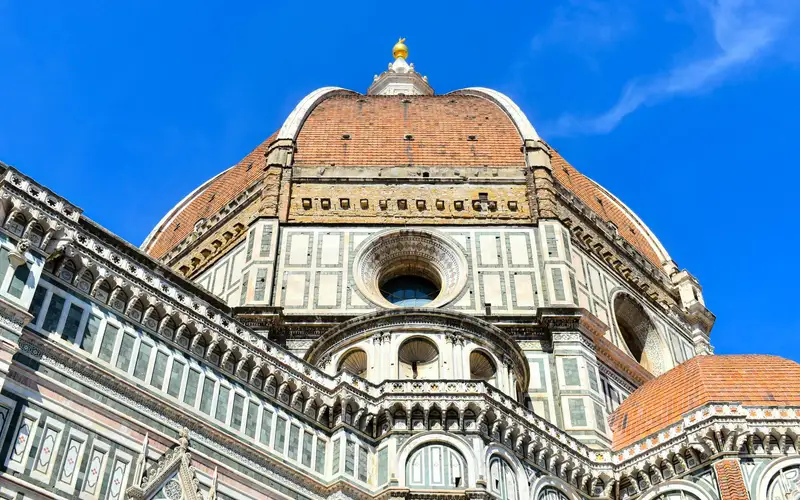
- Florence: about 1 h 30 min from Rome and 2 hours from Venice, the classic stop. Two or three nights let you see the Uffizi and the Duomo and add a day in Tuscany; see our Rome to Florence by train and Florence to Venice by train guides.
- Bologna: for food lovers, one or two nights between the two, with a cooking class or a day trip to Parma or Modena.
- Padua: half an hour before Venice, a good lunch stop for Giotto's Scrovegni Chapel, by timed ticket booked ahead.
- Orvieto: if you go by road, the cathedral town is on the way out of Rome, and the drive continues through Tuscany.
Accessibility: Sala Blu assistance
Roma Termini, Roma Tiburtina and Venezia Santa Lucia have Sala Blu offices run by RFI, which provide free help for travelers with reduced mobility, including a lift to board the train. Book through the SalaBlu+ app or SalaBlu Online at least three working hours ahead, by email at least six hours ahead, or by phone on 800 90 60 60 from an Italian landline or +39 02 32 32 32 from abroad, daily 6:45 a.m. to 9:30 p.m.; RFI asks travelers from abroad to send requests preferably 24 hours ahead. Italo passengers book assistance through Pronto Italo (+39 06 07 08) at least 36 hours before departure, and RFI staff then help at the station. Frecciarossa and Italo trains have wheelchair spaces with an adapted toilet nearby, booked with the ticket. Santa Lucia is step-free to the waterfront, but most Venice bridges have steps, so we choose a hotel reachable by water and book an adapted water taxi; our wheelchair-accessible Italy guide explains how.
Private drivers and door-to-door transfers
On this route we arrange a driver from your Rome hotel to Termini, a porter or water taxi at Santa Lucia, and the timed tickets for any stopover. If you prefer the road, a private driver can take you from Rome to Venice in a full day through Umbria or Tuscany, or over two days with a night in the Val d'Orcia; the car stops at Piazzale Roma, where a water taxi takes over. Door-to-door transfers are quoted on request.
Our 10-day Rome, Florence and Venice by train splits this journey with three nights in Florence, and our 14-day grand tour of Italy starts in Venice and ends in the south. Our Rome travel guide, Venice travel guide and Italy by train guide cover the rest, and our 14-day Italy itineraries show how long to give each city.
If you would like a designer to choose the trains, the stopover and the water taxi for you, tell us about your trip.