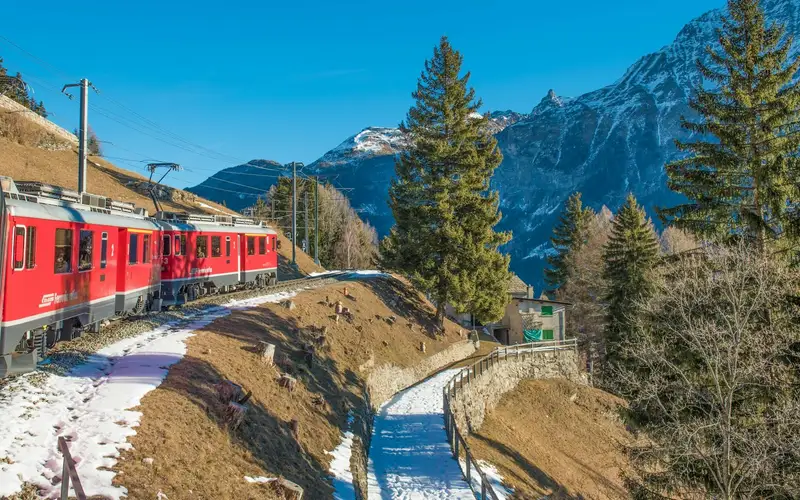
The Glacier Express is often called the slowest express train in the world, and the name is half a joke. It takes about eight hours to cross the Swiss Alps from Zermatt to St. Moritz, over 291 bridges and through 91 tunnels, and nobody on board wants it to go faster. We book this train for our travelers almost every week from May to October, and regularly in winter. Here is what we tell them before they ride it.
The route
The Glacier Express links two car-free or car-light mountain resorts: Zermatt, at the foot of the Matterhorn, and St. Moritz, in the Engadin valley. Some departures run to or from Davos instead of St. Moritz.
The main stretches, from west to east:
- Zermatt to Brig: down the Matter valley, with steep slopes, waterfalls and small Valais villages.
- Brig to Andermatt: up the Goms valley along the young Rhône, past wooden villages and meadows.
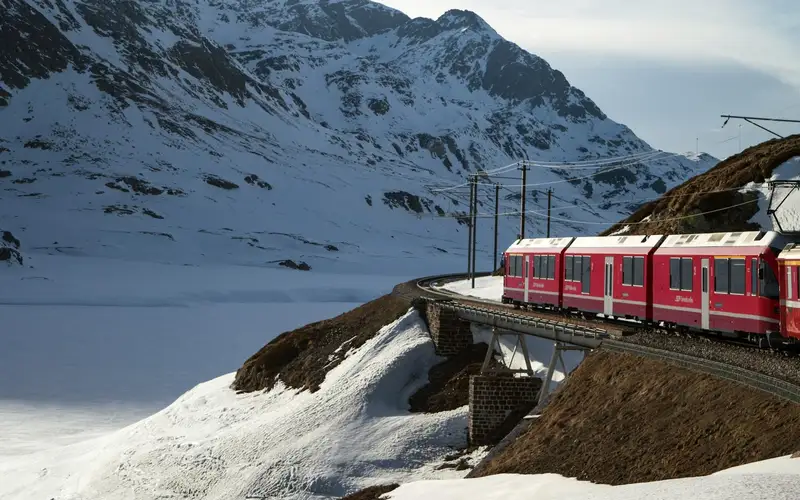
- The Oberalp Pass: the highest point of the route at 2,033 m (6,670 ft), often snowy well into June. This is the moment most people stand up with their phones.
- Disentis to Chur: through the Rhine Gorge, a canyon of white limestone cliffs sometimes called the Swiss Grand Canyon.
- Chur to St. Moritz: the Albula line, part of a UNESCO World Heritage railway, with spiral tunnels and the Landwasser Viaduct, the curved stone bridge that runs straight into a cliff.
The views change every 20 minutes, which is why eight hours goes faster than you expect.
The full journey takes roughly eight hours. In summer there are several departures a day in each direction, and fewer in winter. The train pauses for several weeks in late fall for maintenance before the winter season starts.
You do not have to ride the whole line. Popular shorter sections:
- Chur to St. Moritz (about two hours): the Albula line and the Landwasser Viaduct, the most dramatic engineering.
- Andermatt to Chur: the Oberalp Pass and the Rhine Gorge.
- Zermatt to Andermatt: the Valais side, useful if you continue to Lucerne.
Classes: second, first and Excellence
All Glacier Express cars have panoramic windows that curve up into the roof. The difference between classes is space, comfort and service.
- Second class: four seats around a table, comfortable and fully panoramic. A good choice outside July and August.
- First class: two seats on one side of the table and one on the other, more legroom, quieter cars. Our default for most travelers, since the day is long.
- Excellence Class: one car per train, with every seat at the window, a lounge bar, a dedicated host and a multi-course meal with wine pairings served through the day. It adds a supplement of several hundred francs per person on top of a first-class ticket, and seats are limited.
In first and second class, you can order a hot lunch served at your seat, or bring your own picnic. We pre-order lunch for our travelers so it arrives without fuss.
Is Excellence Class worth it? For a honeymoon, a milestone birthday or travelers who will spend the day in conversation over good food, yes. For travelers who want to watch the scenery and stretch their legs, first class is already excellent and the money is better spent on a special hotel night in Zermatt or St. Moritz.
Tickets and reservations
You need two things: a ticket and a seat reservation. The reservation is mandatory on every Glacier Express train.
- With a Swiss Travel Pass: the ticket is covered, and you only pay the reservation, CHF 54 per person in 2026, one flat price all year.
- Without a pass: you pay the full fare plus the reservation. A Half Fare Card halves the ticket part.
- Excellence Class: you need a first-class ticket or pass plus the Excellence supplement.
Our Swiss Travel Pass calculator shows whether the pass, a Half Fare Card or single tickets costs less for your whole route.
When to book: for June to September, book as soon as reservations open for your date. Summer trains sell out months ahead, especially first class and Excellence. We hold seats for our travelers the day the booking window opens, and we recommend setting your Switzerland dates at least five months ahead for a summer trip.
Which direction?
Both directions show the same landscapes. The difference is how you structure the trip around them.
Zermatt to St. Moritz (eastbound) is our usual choice. You spend two nights in Zermatt first, ride the Gornergrat, then save the Albula line and the Landwasser Viaduct for the afternoon, as the grand finale. From St. Moritz, you can continue on the Bernina Express to Tirano in Italy, then by bus to Lugano.
St. Moritz to Zermatt (westbound) works well if you arrive from Italy or from Zurich via Chur, and want to end the trip in front of the Matterhorn. It fits travelers flying out of Geneva, which is about three and a half hours by train from Zermatt.
Seat side matters less than people think. The line twists constantly through spirals and curves, so both sides of the car get their share of viaducts, gorges and peaks, and the roof windows show the summits from either seat.
Is the Glacier Express worth it?
For most of our travelers, yes, with conditions.
It is worth it if:
- You like trains, or simply like watching landscapes change.
- You can give it a full day without other plans.
- You want to link Zermatt and the Engadin, which you would cross anyway.
It is less worth it if:
- You get restless after three hours seated. Ride a section instead, or take regional trains on the same tracks.
- Your trip is only five or six days. The day is better spent in one region.
- You mainly want photos. The panoramic glass reflects. Many regional trains on the Albula line still have windows that open, which photographers prefer.
Combining Zermatt, the Glacier Express and St. Moritz
Here is the structure we use most often:
- Two nights in Zermatt: the Gornergrat in the morning for the Matterhorn, a walk down through the hamlets, dinner in the village. Read our comparison of Jungfraujoch, Gornergrat and the Schilthorn to choose your summit.
- The Glacier Express in first class, with lunch at your seat.
- One or two nights in St. Moritz: a lake walk, the Engadin villages, or a day trip to the Diavolezza or Muottas Muragl viewpoints.
- The Bernina Express to Tirano, over the 2,253 m Bernina Pass and the spiral viaduct of Brusio, then on to Lugano or Lake Como.
Zermatt is car-free, and luggage space on board is limited. We use Swiss luggage forwarding so your suitcases travel from hotel to hotel while you carry a daypack. It is one of the small details that change the day.
Pace and season: when to ride it
The advice we give most often about this train is about pace. Ride it on a rest day in the middle of your trip, not the day after you land. Jet lag and eight hours of gentle rocking do not mix well, and you will sleep through the Rhine Gorge.
Our second tip is about season. Everyone pictures the Glacier Express in July, but our designers' favorite runs are in early June, with snow still on the Oberalp and meadows in flower below it, and in January, when the whole line is white. Winter seats are easier to get and the reservation costs less.
And if you love the line, do not ride the whole of it twice. Take the Glacier Express one way, then come back on the regional trains through other valleys. Switzerland has no shortage of beautiful tracks.
Trips built around the Glacier Express
The Glacier Express is the centerpiece of Legendary Swiss Trains, seven days with the GoldenPass, Gornergrat and Bernina Express, and of Switzerland by Train in 12 Days, which adds Lavaux, Gruyères and Jungfraujoch. Both fit our 10-day Switzerland itineraries if you want to shorten or stretch them. See all our train trips, or download our Europe by train guide for the wider picture. If you are arriving from France, read Paris to Switzerland by train, and check the best time to visit Switzerland before fixing dates.
Send us your dates and one of our travel designers will check Glacier Express availability, hold your seats and draw a custom version of this route within 48 hours.