Switzerland is one of the easiest countries in Europe to visit in a wheelchair, but not for the reason most guides give. The country is not step-free everywhere. What it has is a rail system that tells you, train by train and platform by platform, where you can roll on and where you need help, and a free assistance service that comes to the platform if you book it an hour ahead. Build the trip around that, check every hotel bathroom yourself, and Switzerland works very well. Ignore it, and a single old station or a cobbled old town can undo a day.
This is how we plan wheelchair accessible trips to Switzerland: the trains, the mountains, the cities and the hotels, with the limits stated plainly.
Swiss trains: what is step-free and what is not
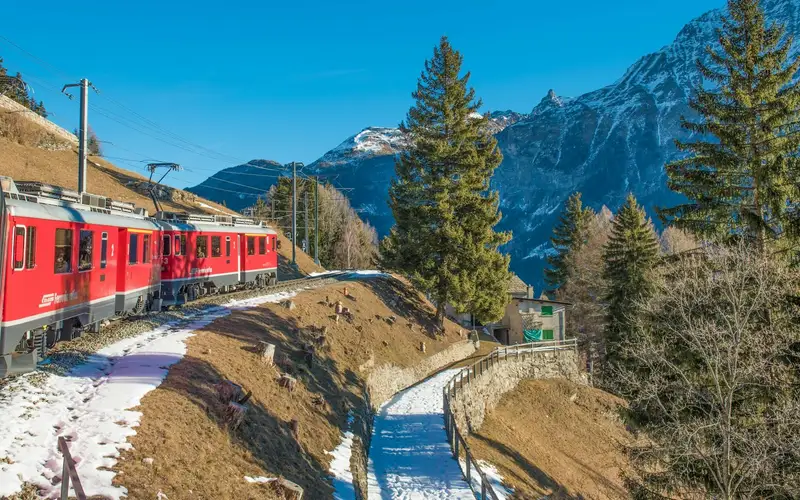
The new trains are level along their whole length. SBB states that its newer rolling stock (the long-distance double-deck trains, the Giruno, the InterRegio double-deck and the newer regional and S-Bahn trains) offers level boarding along the entire train, not only in the wheelchair area, wherever the platform has been raised to the standard height of 55 cm. These trains have wheelchair spaces and accessible toilets.
The stations are not finished. Switzerland's Disability Discrimination Act set a target for step-free public transport, and SBB says openly that it has not met it. By its own count, more than 400 of its 764 stations still need conversion, and the work is expected to run into the mid-2030s. Older high-floor carriages are also still in service on some lines.
How to know before you go. The SBB online timetable and the SBB Mobile app show, for each connection, whether boarding is independent, whether help is needed, and which platform sector the low-floor car stops at. This is the single most useful accessibility tool in Europe, and it is the first thing we check when we draft a Swiss route.
Where you cannot board on your own, SBB staff will meet you with a mobile lift or ramp, free of charge.
| What you need |
How to book |
Notice required |
| Help boarding or leaving a train in Switzerland |
Phone 0800 007 102 (free in Switzerland), +41 800 007 102 from abroad, daily 5 am to midnight |
At least 1 hour (2 hours in some cases) |
| Online instead of phoning |
AMO system at swisspass.ch/handicap, with a SwissPass login |
Same as above |
| Stations served by a shuttle service |
Contact Center Handicap |
At least 2 hours |
| Departures before 6 am |
Contact Center Handicap |
By 11 pm the night before |
| International trains (from Paris, Milan, Germany) |
Contact Center Handicap, with your coach and seat number |
At least 24 hours |
Two details people miss. Assistance staff do not carry luggage, so we either book SBB's separate luggage service or send bags ahead with a private transfer. And you need your exact train and seat, so we reserve seats in the wheelchair area on every leg, even where Swiss trains do not require reservations.
The scenic trains and mountain excursions
This is where Switzerland surprises people, in both directions.
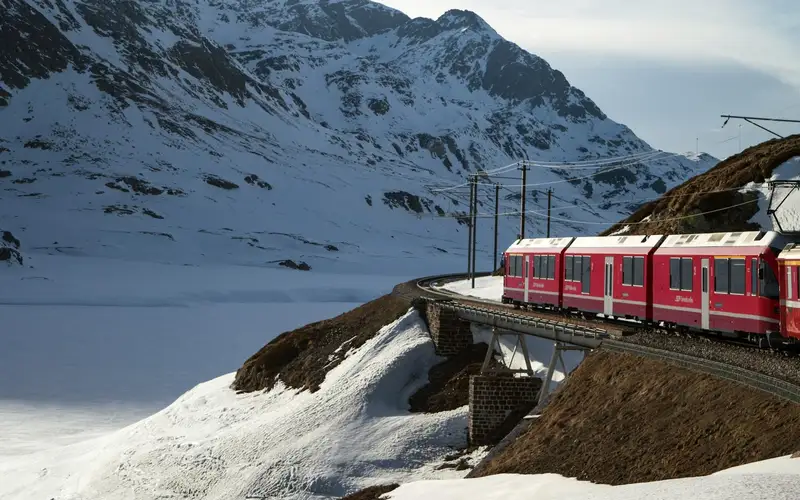
Glacier Express. The official operator states that each train has a wheelchair space with an accessible toilet in the first-class section. A seat reservation is mandatory for the wheelchair user and the companion, ideally seat 11 in that car, and it must be made at least 24 hours before travel. If you stay in your own chair, the reservation goes through Glacier Express central reservations. Boarding is by mobile lift: you wait beside it on the platform 10 minutes before departure. Excellence Class is a different car; we do not assume it can take a wheelchair and ask the operator case by case. Our Glacier Express guide covers the route itself.
Jungfraujoch. The Jungfrau Railways state that the route from Interlaken Ost to Grindelwald Terminal, then the Eiger Express gondola to Eigergletscher and the train to the Jungfraujoch, is barrier-free, and that you can travel barrier-free to the Jungfraujoch itself. Inside the summit complex, we confirm with the railway which areas (the Sphinx terrace, the Ice Palace, the Plateau) are open and step-free for your date. The older route via Kleine Scheidegg needs advance booking by phone and staff help at stations. Two cautions: the summit is at 3,454 m, and the thin air tires everyone, so we keep the rest of that day light; and some outdoor areas are snow-covered and slippery. Our comparison of Jungfraujoch, Gornergrat and Schilthorn helps if you are choosing one summit.
Gornergrat, Pilatus, Rigi and the other cogwheel railways. Each railway publishes its own accessibility information and has its own car layouts and summit terrain. We confirm the car, the boarding point and the summit route with the railway before we book, rather than relying on the general statement that a mountain is "accessible".
Lake boats. Boats on Lake Lucerne and Lake Geneva are among the most relaxing ways to see Switzerland from a wheelchair, but access varies by ship and by pier (gangway angle, toilet, which deck). The SBB timetable also covers boats; we pick the sailings and the ship accordingly.
Swiss cities: terrain, trams and old towns
| City |
What works |
What to watch |
| Zurich |
Compact, mostly flat center along the Limmat and the lake; low-floor trams on most lines; the main station is step-free with lifts |
Cobbled lanes in the Niederdorf and the climb to the Lindenhof |
| Lucerne |
Flat lakefront promenades and quays; the station, boat piers and concert hall are side by side |
The old town lanes are cobbled; the Musegg wall towers are climbed by stairs |
| Bern |
Long arcades give shelter, trams and buses are frequent |
The old town sits on a slope above the Aare, with steep side streets and cellar shops down steps |
| Basel |
Trams everywhere, the Rhine promenade on the Kleinbasel side is level |
The Münster hill is cobbled and steep from the river |
| Geneva and Montreux |
Long, flat lakeside quays; Montreux's promenade runs for kilometers |
Geneva's old town is up a hill; Chillon Castle is medieval, with stairs in much of the visit |
| Zermatt |
Car-free, so traffic is quiet |
The village slopes up from the station and there are no ordinary taxis; we check how the hotel moves guests from the station |
In every city, the pattern is the same: modern districts, stations and lakefronts are easy; medieval centers are cobbled and often on a hill. We plan the old towns with a local guide who knows the smoothest line through them, and keep lakeside days for the long outings.
Hotels: what we check before we confirm a room
Swiss hotels are usually well maintained, but an "accessible room" label means little on its own. Many classic lake and mountain hotels are older buildings with a step at the entrance or a lift the size of a phone booth. Before any hotel goes into one of our itineraries, we ask for photos and measurements of:
- the entrance and the route to reception and the lift, step by step;
- the lift door width and cabin depth, compared with your chair;
- the room door and bathroom door widths;
- the shower: roll-in or a tray with a lip, fixed or fold-down seat, grab bar positions;
- the bed height and the clear space on the transfer side;
- the route from the hotel to the station or boat pier, including slopes.
We do this ourselves because public listings are uneven. The independent databases are useful starting points: RolliHotel.ch classifies Swiss accommodation on detailed criteria such as sliding doors, grab rails and seat heights, and the free Ginto app rates hotels, restaurants and sights down to door widths and parking spaces. We cross-check both against what the hotel sends us.
Swiss organizations worth knowing
- Procap is Switzerland's largest self-help organization for people with disabilities. Its travel information service, formerly known as Mobility International Switzerland (MIS), collects information on barrier-free travel and accessible providers.
- The SBB Contact Center Handicap (above) also suggests suitable connections in Switzerland and abroad.
- Regional tourist offices, such as Graubünden's "without barriers" pages and the Jungfrau Region, publish accessible excursion ideas.
A realistic accessible route through Switzerland
For a first trip, we usually suggest three bases and no more than one hotel change every three nights:
- Lucerne, 3 nights. Lakefront hotel, a boat day on the lake, the old town with a guide, a modern museum for the bad-weather day.
- Interlaken or Grindelwald, 3 nights. The Jungfraujoch via the Eiger Express on the clearest day, Lake Brienz by boat, a flat walk in the Lauterbrunnen valley.
- Montreux, 3 nights. The lakeside promenade, the Lavaux vineyards seen from the train or by adapted vehicle, and, if you wish, the Glacier Express as a day on rails from Zermatt or as the transfer between regions.
This is the shape of our Switzerland in 7 Days itinerary, which we rebuild with accessible hotels, reserved wheelchair spaces and assistance bookings on every leg. Rail-minded travelers can start from Legendary Swiss Trains instead. Our Swiss Travel Pass calculator shows whether a pass pays for your route.
When to go
June to September has open mountain lifts, boats on the full timetable and dry paths. December is beautiful, and the markets in Basel and Montreux sit on flat squares and quays (we cover them in our guide to Christmas markets in Switzerland), but snow and ice make outdoor surfaces harder and some summits close their terraces. We avoid the last week of July and the first week of August on the Jungfrau line, when trains are fullest.
If you are combining Switzerland with France, our guide to wheelchair accessible Paris covers the other end of the classic Paris to Switzerland route, and our accessible trips page shows what we have already designed.
Tell us about your chair, your transfers and the views you want to see, and Caroline or another of our travel designers will design a custom Swiss route checked hotel by hotel and train by train.