Give Tuscany a week if you can: two or three nights in Florence for the art, then three or four nights in the countryside for the hill towns, the wine and the long lunches. The countryside needs a base of its own, because the Val d'Orcia, Montalcino and Montepulciano are 1 h 30 or more from Florence by road. Choose a farm stay in Chianti for wineries close to Florence, or the Val d'Orcia for the cypress-lined hills and Brunello; add Siena or Lucca if you prefer a town. Rent a car once you leave Florence, or better, book a driver for the wine days, and keep away from the camera-controlled limited traffic zones of the historic centers.
We have designed Tuscany trips for food lovers, honeymooners, families and travelers with limited mobility. This guide covers how long to stay, which base to choose, how to get around, what to book ahead in 2026, the towns worth a day, food and wine, the seasons and what we steer travelers away from. For Florence itself, read our Florence travel guide.
Tuscany at a glance
|
|
| Nights we suggest |
3 to 4 in the countryside, plus 2 to 3 in Florence |
| Best bases |
Florence, Siena, a Chianti farm stay, the Val d'Orcia or Montepulciano, Lucca |
| Getting around |
car or private driver; trains to Siena, Lucca, Pisa and Cortona |
| Watch out for |
ZTL limited traffic zones in every historic center |
| Wine areas |
Chianti Classico, Montalcino (Brunello), Montepulciano, San Gimignano |
| Best months |
April to June, September and October |
How many days in Tuscany
- Three nights in the countryside: one base, two full days. Enough for Chianti and Siena, or for the Val d'Orcia with Montalcino and Pienza.
- Five to seven nights: two bases, for example Chianti then the Val d'Orcia, or Florence then a farm stay near Montepulciano. This is the trip most of our travelers choose.
- Ten days or more: Florence, a countryside base, then Lucca or the coast, at an unhurried pace.
For how Tuscany fits with Rome, Venice and the coast, see how many days in Italy. Coming from Rome, the train to Florence takes about 1 h 30: our Rome to Florence by train guide has the detail.
Where to stay in Tuscany: the bases compared
| Base |
Why choose it |
Watch out for |
| Florence |
museums, restaurants, trains everywhere |
day trips to the south of Tuscany are long |
| Siena |
a Gothic city with evenings on the Piazza del Campo, between Chianti and the Val d'Orcia |
steep streets, a 24-hour ZTL, full hotels during the Palio |
| Chianti farm stay (agriturismo) |
vineyards, pools, dinners with the estate's wine, 30 to 60 minutes from Florence |
you need a car or a driver for everything |
| Val d'Orcia and Montepulciano |
the classic Tuscan landscape, Brunello and Vino Nobile, Pienza's pecorino |
1 h 30 or more from Florence, quiet evenings |
| Lucca |
a flat walled town with a station, easy for Pisa and the coast |
far from the wine hills of the south |
Most first-time visitors are happiest with Florence plus one country base. We usually choose a farm stay in Chianti for travelers who want wine and a pool within reach of Florence, and the Val d'Orcia for those who want the landscape of the postcards. Siena suits travelers who would rather walk to dinner than drive, and Lucca suits those who travel by train.
Getting around Tuscany
By car. The countryside is made for driving, with country roads between the vineyards. Three rules we give everyone:
- Carry an International Driving Permit with your US license. The US Embassy in Italy advises American drivers to get one before leaving, and AAA issues it for $20.
- Never drive into a historic center. Florence, Siena, Lucca, Montepulciano and most hill towns are limited traffic zones (ZTL) watched by cameras. In Siena, the ZTL applies 24 hours a day, every day; a hotel inside it can register your plate for one entry a day, of up to two hours, to drop off luggage. In Florence, the zone is active on weekdays from 7:30 a.m. to 8 p.m. and on Saturdays until 4 p.m. Park in the lots outside the walls and walk up.
- Pick up the car as you leave Florence, not before. Highway tolls can be paid by card or cash.
With a private driver. For wine days, a driver is the only sensible choice: Italy has strict drink-driving laws, and Chianti tastings follow one another. We also use drivers for the transfer between bases.
By train. Direct regional trains link Florence to Siena in about 1 h 30 (Siena station is about 3 km below the old town), to Lucca in about 1 h 20 and to Camucia-Cortona in about 1 h 20 to 1 h 30, below the hill town. Chianti and the Val d'Orcia have no useful train service, and buses there are infrequent.
| Drive |
Approximate time |
| Florence to Greve in Chianti |
about 30 minutes |
| Florence to Siena |
about 1 hour |
| Siena to Montalcino |
about 1 hour |
| Florence to Montepulciano |
about 1 h 30 to 1 h 45 |
| Pienza to Montepulciano |
about 20 minutes |
What to book ahead in 2026
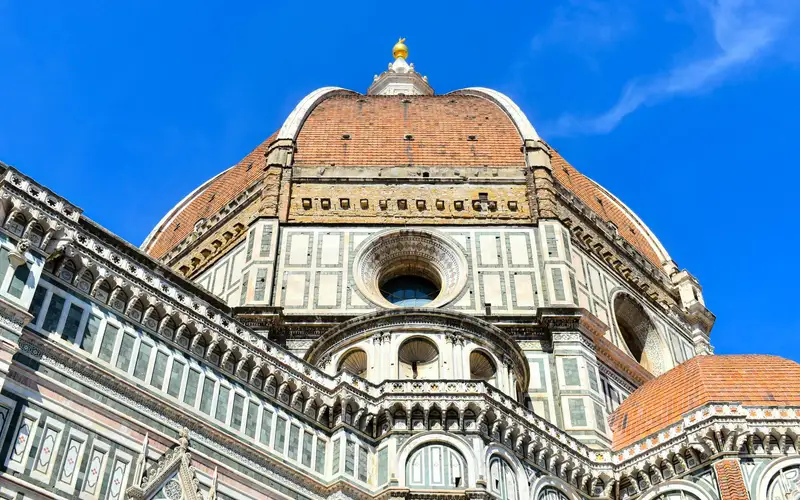
- Florence's museums. The Uffizi, the Accademia and the Duomo dome all need timed tickets: see the Florence guide.
- Siena Cathedral. The OPA SI Pass covers the cathedral, the Piccolomini Library, the Baptistery, the crypt, the museum with the panorama from the unfinished facade, and the Oratory of San Bernardino, for three consecutive days. It costs €14 (about $16), or €16 (about $19) when the cathedral's marble floor is uncovered, from late June through July and from mid-August into the fall. The rooftop visit, the Porta del Cielo, is a separate ticket at €21 (about $24).
- The Palio of Siena runs on July 2 and August 16, on the Piazza del Campo. Siena's hotels fill months ahead for both dates: tell us early if you want to be there, or we plan around them.
- Wineries. Most estates receive visitors by appointment only. We book family producers rather than large tasting rooms, with lunch at the estate when possible.
- Benvenuto Brunello, the release of the new Brunello vintage, takes place in Montalcino from November 19 to 23, 2026, with tastings open to wine lovers from November 21.
The places worth a day
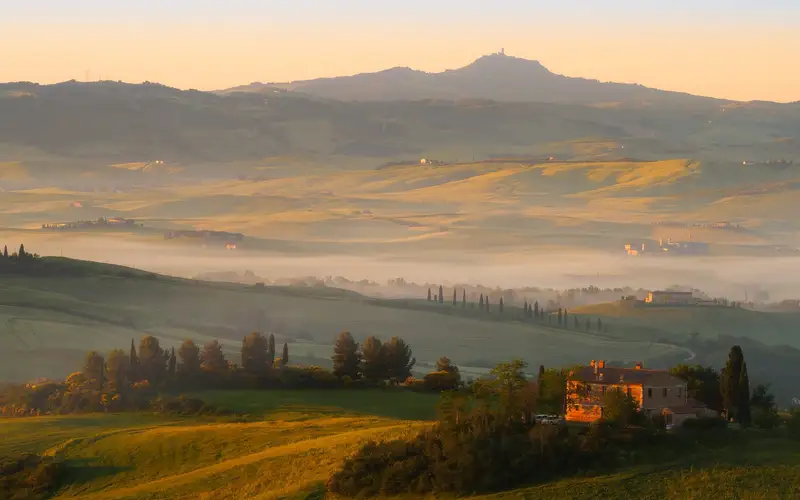
Val d'Orcia. A farming landscape inscribed as a UNESCO World Heritage site in 2004: rolling wheat fields, cypress avenues and the villages of Pienza, San Quirico d'Orcia, Bagno Vignoni with its thermal pool in the square, and Castiglione d'Orcia. Pienza, rebuilt as an ideal Renaissance town, is the place for pecorino.
Montalcino. The hill town of Brunello di Montalcino, made only from Sangiovese and released no earlier than January 1 of the fifth year after the harvest, so the 2021 vintage reached the market in January 2026. The Sienese fortress, begun in 1361, has a walkway on its walls.
Montepulciano. A long, steep hill town of Renaissance palaces and cellars carved under the streets, home of the Vino Nobile. Pair it with Pienza, 20 minutes away.
Cortona. A hill town above the Val di Chiana, with views to Lake Trasimeno, best combined with a night in the south.
Chianti. The Chianti Classico area covers about 71,800 hectares between Florence and Siena, around Greve, Radda, Castellina and Gaiole. Its black rooster emblem goes back to the medieval Chianti League. We spend a day there with two family wineries and a long lunch.
Lucca and Pisa. Lucca's Renaissance walls form a 4.2 km circuit, topped by a tree-lined promenade where people walk and cycle. Pisa is a half day: the Leaning Tower and the Square of Miracles.
Food and wine, and what to skip
Tuscan cooking is country food: hand-rolled pici with garlic sauce or ragù, ribollita, bistecca alla fiorentina, wild boar, pecorino from Pienza, and the new olive oil, green and peppery, from late October. The wines follow the map: Chianti Classico between Florence and Siena, Brunello in Montalcino, Vino Nobile in Montepulciano, white Vernaccia in San Gimignano.
What we steer travelers away from:
- Trying to see everything from Florence. Siena, San Gimignano, Chianti and the Val d'Orcia in one day means eight hours in a car.
- Big-bus wine tours with three tastings in tasting rooms built for groups.
- One-night stops. Every move costs half a day; two nights per base is our minimum.
- San Gimignano at midday in summer, when the coaches arrive. Go early or in the evening.
Tuscany through the seasons
Spring, from April to June, is green, with wildflowers in the Val d'Orcia and comfortable temperatures. Summer is hot and dry, the wheat turns gold, and July and August bring the Palio and full hotels. September and October are harvest time, the grapes first, then the olives from late October into November. In November, San Miniato holds its white truffle fair on the last three weekends of the month (November 14 to 29, 2026). Winter is quiet, with some country hotels closed, but Florence and Siena at their calmest. Our best time to visit Italy guide compares the months, and our Italy trip cost guide prices a Tuscany week.
Tuscany with limited mobility
Tuscany is a region of hill towns, and most historic centers climb. Siena is steep, and the Piazza del Campo slopes toward the town hall; Montepulciano and Cortona are among the steepest. Lucca is the easiest: its center is flat, the city publishes accessible routes with tactile paths, and the paths of its botanical garden suit wheelchairs. In Montalcino, the walkway on the fortress walls is accessible. For wheelchair users, we choose farm stays with ground-floor rooms and a level path to the dining room, and an adapted vehicle with a driver who drops you at the top of the hill towns, where the lanes are flatter.
Trips that include Tuscany
Our Tuscany Food and Wine in 8 Days spends three nights in Florence with a day in Chianti, then four nights in the Val d'Orcia, with Siena, a Brunello cellar in Montalcino, a cooking class in a farmhouse, Pienza and Montepulciano. For a first Italy trip, Rome, Florence and Venice by Train in 10 Days includes a private day in Siena and Chianti. More ideas are on our food and wine trips page.
Tell us how you like to travel, and one of our travel designers will build your Tuscany week, with the farm stay, the driver and the wineries chosen for you.