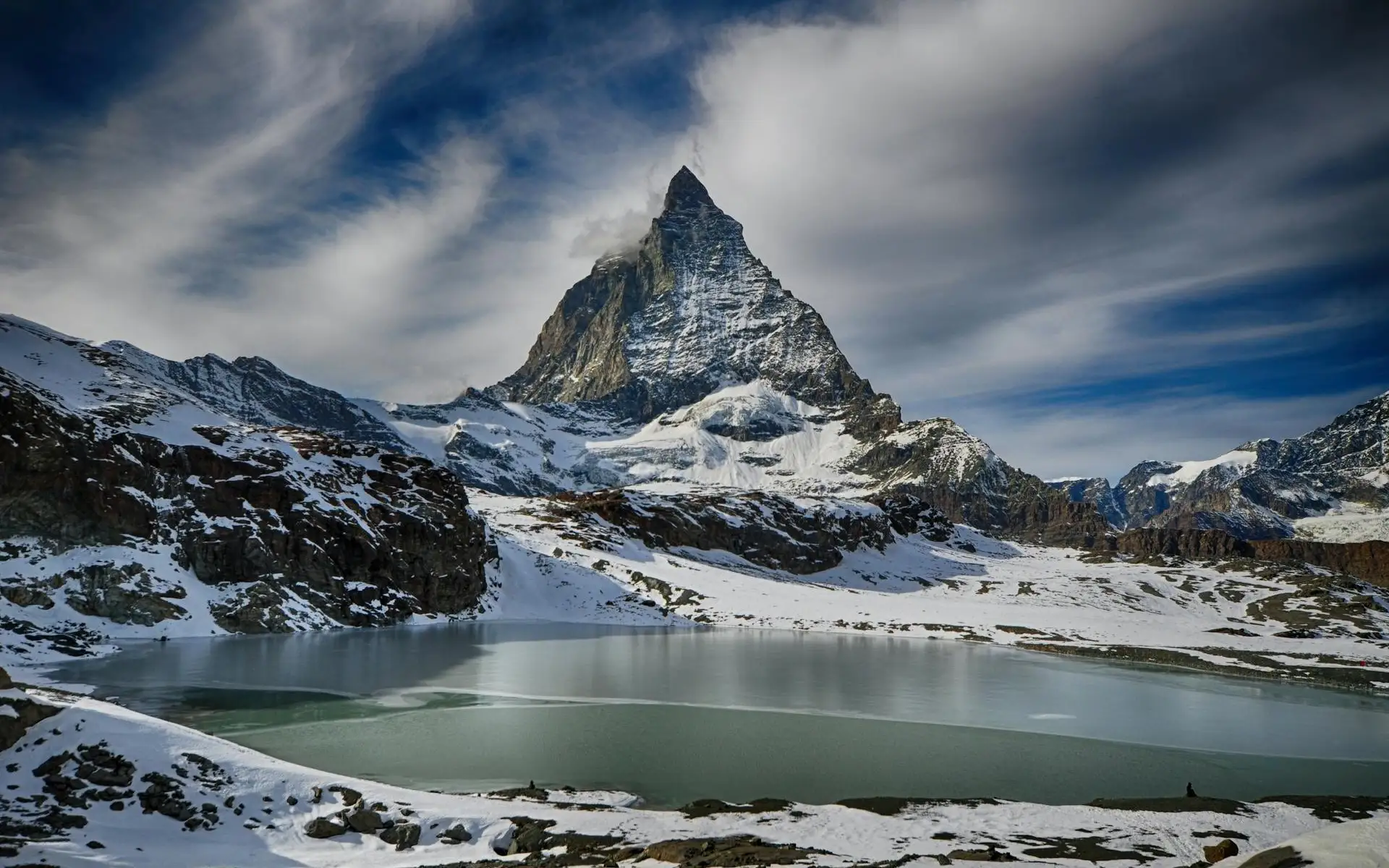
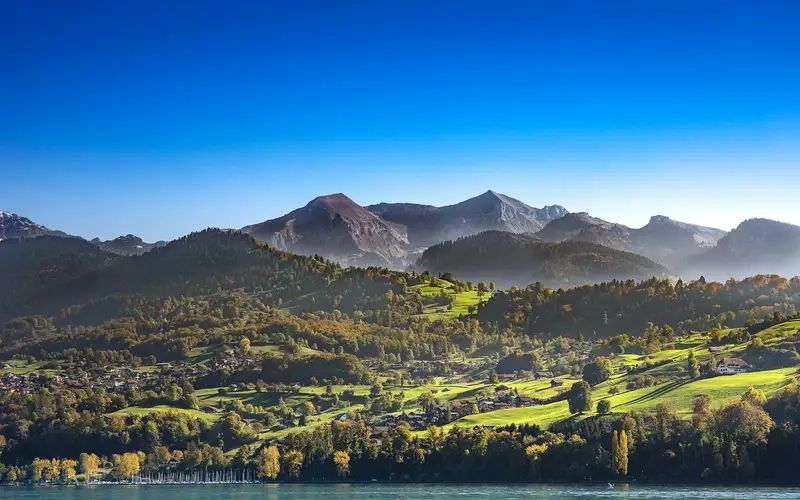
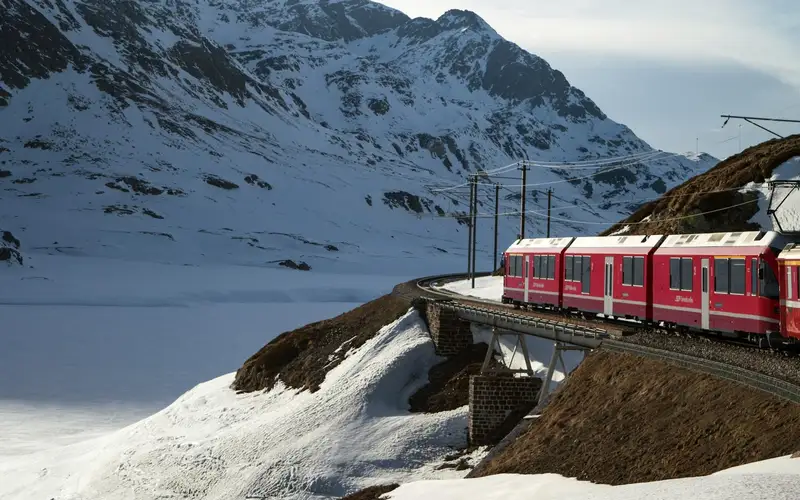
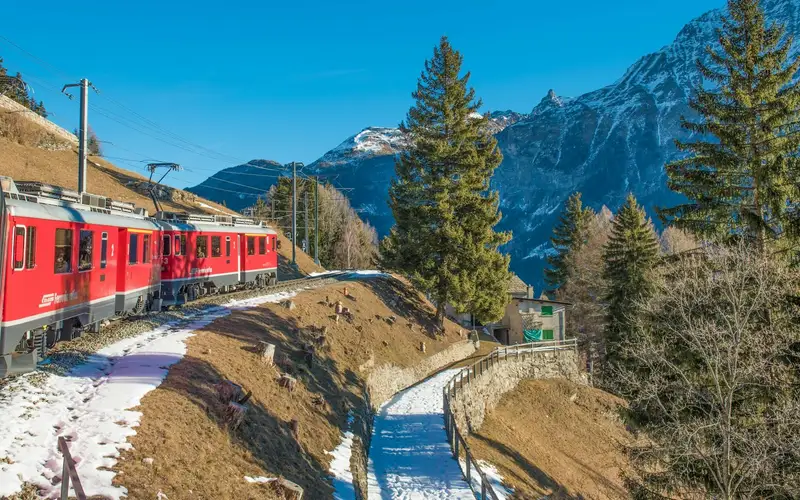
For a first trip, stay in two or three bases rather than one: Lucerne for the lakes, the Jungfrau region (Grindelwald, Wengen or Interlaken) for the high Alps, and Zermatt for the Matterhorn. Add Montreux or Lausanne on Lake Geneva if you fly out of Geneva, and Lugano or St. Moritz if you have ten days or more. Switzerland is small and its trains are fast, so a well-placed base gives you three or four day trips without repacking.
Most "where to stay" lists rank towns. We think it is more useful to choose a region first, then the right village or street inside it, because that second choice decides whether you wake up to the Eiger or to a parking lot.
Our Swiss bases at a glance
| Base |
Best for |
From Zurich (train) |
Car-free |
Nights we suggest |
| Lucerne |
Lakes, old town, Rigi and Pilatus, first night after the flight |
about 45 min |
No |
2 to 3 |
| Interlaken |
Flat, central hub for the Jungfrau region, easy logistics |
about 2 h |
No |
2 to 3 |
| Grindelwald |
Eiger views, hiking, First and Jungfraujoch |
about 2 h 30 |
No |
2 to 4 |
| Wengen |
Quiet car-free village, Lauterbrunnen views |
about 2 h 45 |
Yes |
2 to 4 |
| Mürren |
Cliff-top village, Schilthorn, total calm |
about 3 h |
Yes |
2 to 3 |
| Zermatt |
Matterhorn, Gornergrat, winter and summer |
about 3 h 15 |
Yes |
2 to 3 |
| Montreux or Lausanne |
Lake Geneva, Lavaux vineyards, Chillon |
about 2 h 30 |
No |
2 to 3 |
| Lugano |
Italian-speaking lakes, mild weather |
about 2 h |
No |
2 to 3 |
| St. Moritz or Pontresina |
Engadine, Bernina Express, winter sports |
about 3 h 15 |
No |
2 to 3 |
Times are typical fastest connections and vary by timetable. Zurich Airport has its own station under the terminal, so Lucerne is about an hour from landing to lakefront.
How we choose bases
Three rules shape every Swiss itinerary we design:
- Never fewer than two nights in a base. A one-night stop costs you half a day of packing and check-in, and in the mountains it also costs you your weather backup.
- Sleep up high only if you will use it. A mountain village is magical at dawn and dusk, but if you plan a lake day and a city day, a valley base is easier.
- Match the base to the summit. The Jungfraujoch, Gornergrat and Schilthorn each belong to a different base. Decide which one matters most, then sleep at its foot.
Lucerne: the easiest first base
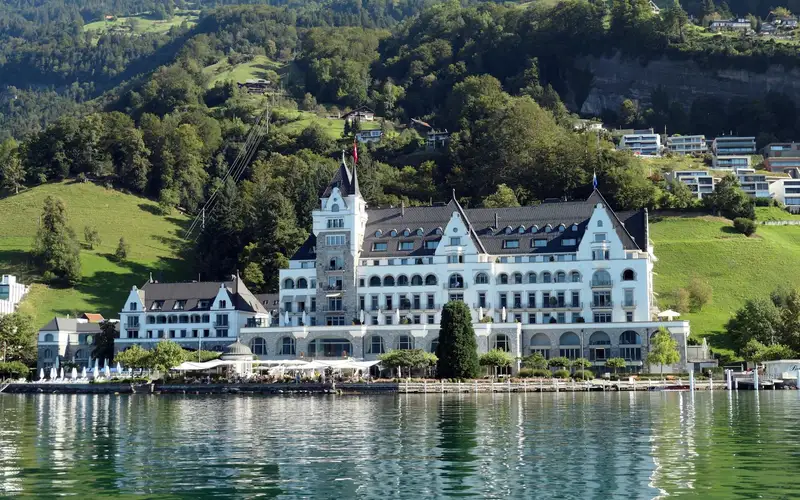
Lucerne works for almost every traveler. The old town, the Chapel Bridge and the lake promenade are walkable and mostly flat, boats leave from in front of the station, and Mount Rigi, Pilatus and Titlis in Engelberg are all day trips.
Where to stay in Lucerne:
- The lake promenade (Schweizerhofquai and Haldenstrasse): grand hotels with lake and mountain views, a few minutes' walk from the old town. Our first choice.
- The old town: atmospheric, car-free streets, smaller hotels. Ask for a room away from the bars on the river.
- Near the station: the most practical for luggage and early trains, and still walking distance to everything.
Lucerne also makes a good first night after a transatlantic flight: no mountain roads, no connections, and an easy evening walk.
The Jungfrau region: four very different choices
The Bernese Oberland is where most of our travelers want to see snowcapped peaks, and it offers the widest range of bases. Choosing between them is where the trip is made or lost.
Interlaken
Interlaken sits on the valley floor between Lake Thun and Lake Brienz. It is the transport hub: trains to Grindelwald take about 35 minutes, to Lauterbrunnen about 20, and the lake boats leave from both of its stations. It is flat, with the largest choice of hotels and the most step-free rooms in the region.
The trade-off: Interlaken is a town, not a mountain village, and you see the Jungfrau from it rather than living under it. We compare it in detail with Lucerne in Interlaken vs Lucerne.
Grindelwald
Grindelwald faces the north face of the Eiger and is the base for the Jungfraujoch via the Eiger Express gondola, for First and its cliff walk, and for many of the classic hikes. It is reachable by car and has the most life in the evening. In July and August its main street is busy with day visitors.
Wengen
Wengen is car-free, perched on a shelf above the Lauterbrunnen valley, and reached only by the cog railway. It is our pick for couples and families who want calm and long views. Trains continue up to Kleine Scheidegg and the Jungfraujoch, so it is as good as Grindelwald for the summit.
Mürren and Lauterbrunnen
Mürren is also car-free, higher and smaller than Wengen, and sits right at the foot of the Schilthorn cable car. It is the quietest of the four. Lauterbrunnen, on the valley floor below, is a practical, lower-priced base surrounded by waterfalls, but its sun hours are short in spring and fall because of the cliffs.
Zermatt: stay there, never day-trip
Zermatt is a three-hour train ride from Zurich or about three and a half to four hours from Geneva. That alone is why we never plan it as a day trip. The village is car-free: drivers leave their car in Täsch and take a shuttle train for the last few minutes, and inside the village small electric taxis and hotel shuttles carry luggage.
Where to stay in Zermatt:
- Near the station and the Bahnhofstrasse: flat, practical, close to the Gornergrat railway.
- Toward the church and the river: the heart of the village, with many Matterhorn-view rooms.
- Winkelmatten and the slopes above: quieter, with wide views, but uphill. Ask for the hotel's shuttle.
A Matterhorn-view room is worth paying for here more than anywhere else in Switzerland. The mountain changes color at sunrise and you see it from bed.
Lake Geneva: Montreux, Vevey or Lausanne
If your trip starts or ends in Geneva, or arrives from Paris on the TGV Lyria, a base on Lake Geneva is the natural first or last stop.
- Montreux: a lakeside promenade, palm trees, Chillon Castle a walk or a short bus ride away, and the GoldenPass line into the mountains.
- Vevey: smaller and calmer, with direct access to the Lavaux vineyard terraces.
- Lausanne: a real city with museums and steep streets; the metro climbs from the lake to the old town.
We tend to put couples and wine lovers in Vevey or Montreux and travelers who like cities in Lausanne. Geneva itself works for a final night before the flight.
Ticino and the Engadine for longer trips
With ten days or more, a third or fourth region changes the trip:
- Lugano brings palm trees, Italian food and lake swimming, about two hours from Zurich through the Gotthard Base Tunnel. Ascona and Locarno on Lake Maggiore are the quieter alternative.
- St. Moritz or Pontresina in the Engadine is where the Glacier Express ends and the Bernina Express begins. St. Moritz is glamorous and lively in winter; Pontresina is smaller and calmer.
Zurich and Geneva: one night, or skip
Zurich is a pleasant city with a lovely old town around the Niederdorf and the lake. But most of our travelers come to Switzerland for lakes and mountains, so we usually treat Zurich and Geneva as arrival or departure nights, or skip them entirely by taking the train straight from the airport to Lucerne or Montreux.
Sample base combinations by trip length
| Trip length |
Bases we would choose |
| 5 days |
Lucerne 2 nights, Grindelwald or Wengen 3 nights |
| 7 days |
Lucerne 2, Wengen or Grindelwald 2, Zermatt 2, plus a last night on Lake Geneva |
| 10 days |
Lucerne 2, Jungfrau region 3, Zermatt 2, Montreux or Vevey 2 |
| 14 days |
Lucerne 3, Jungfrau region 3, Zermatt 2, St. Moritz 2 (via the Glacier Express), Lugano 3 |
Our Switzerland in 7 Days follows the 7-day pattern from Lucerne to the Jungfrau region, Zermatt and Lavaux, from €1,999 (about $2,300) per person. With twelve days, Switzerland by Train in 12 Days adds the Glacier Express at an easier pace, and every Switzerland trip we design can swap a base to suit you. If you are still deciding on the length, read how many days in Switzerland.
Luggage and car-free villages
Three of our favorite bases, Zermatt, Wengen and Mürren, have no private cars. That is part of their charm, but it changes how you pack. Large suitcases are a struggle on cog railways and cable cars, so we often send big bags ahead with the Swiss railways' luggage service and keep a small overnight bag for the mountain nights. Hotels in car-free villages meet guests at the station with an electric cart if you ask in advance.
A Swiss Travel Pass covers most of the trains between these bases, but not all the mountain railways in full, so the pass that fits depends on which bases you pick.
Step-free bases for reduced mobility
Lucerne and Interlaken are the two easiest Swiss bases for travelers using a wheelchair or walking with difficulty: flat centers, large modern hotels and step-free boarding on most trains. Zermatt works well too thanks to its electric taxis, but the village is steeper than it looks from the station. Wengen and Mürren are car-free and sloped, and some hotels there have no elevator, so we check each room and route before we book.
What we steer travelers away from
- Interlaken as your only mountain base if what you want is to wake up in an alpine village.
- Zermatt as a day trip from Lucerne or Geneva.
- Five or more bases in seven days. The trains are easy; repacking is not.
- Remote mountain hotels without a car or shuttle for the first night after a long flight.
Tell us which summits, lakes and trains matter most to you, and a travel designer will match each one to the right base in a custom Switzerland itinerary.