Prague, Vienna and Budapest by train is the easiest three-capital trip in Europe. Direct trains link Budapest and Vienna in about 2 hours 50 minutes and Vienna and Prague in about 4 hours 15 minutes, city center to city center. Travel the three cities in a line, give each two or three nights, and you need 7 to 10 days in total. We plan this route in every season, and this is how we build it.
The route at a glance
| Leg |
Typical time |
Direct trains |
Advance fare from (2026) |
| Budapest Keleti to Vienna Hauptbahnhof |
about 2 h 50 |
every hour, Railjet or EuroCity |
ÖBB Sparschiene and MÁV advance fares, limited per train |
| Vienna Hauptbahnhof to Prague hlavní nádraží |
about 4 h 15 |
Railjet roughly every two hours |
€18.50 (about $21) in 2nd class, €30 in 1st |
| Prague to Budapest, if you skip Vienna |
about 6 h 50 |
several a day via Brno and Bratislava, arriving at Budapest Nyugati |
€30 (about $35) in 2nd class |
The times come from the Austrian railway timetable for late 2026 and 2027. The fares are the lowest advance prices published by the Czech railways (České dráhy) for 2026; between Budapest and Vienna, the Austrian (ÖBB) and Hungarian (MÁV) advance fares move with demand, so we quote them for your exact train. All are limited in number and valid only on the train you book, and flexible tickets bought on the day cost much more.
Which order: Prague first or Budapest first?
Either works, because the trains run the same way in both directions. What decides it is your flights. Book an open-jaw ticket, arriving in one end and flying home from the other, so you never ride the same line twice. We compare both directions for every traveler and choose the better flight combination.
When the flights cost the same, our Budapest, Vienna and Prague by train itinerary starts in Budapest, for three reasons. A morning in the thermal baths is the best cure for jet lag we know. The shorter train ride comes first, so the first transfer day feels easy. And Prague, the most walkable of the three, makes a relaxed finale.
Avoid the direct Prague to Budapest train unless you are leaving Vienna out. Nearly seven hours is a full day, and Vienna sits almost exactly halfway.
How many days in each city
| Trip length |
Budapest |
Vienna |
Prague |
Who it suits |
| 7 days, 6 nights |
2 nights |
2 nights |
2 nights |
A first look, tight but workable |
| 8 days, 7 nights |
3 nights |
2 nights |
2 nights |
Our published itinerary |
| 10 days, 9 nights |
3 nights |
3 nights |
3 nights |
Museums, a day trip, slower mornings |
| 12 days, 11 nights |
3 nights |
3 nights |
3 nights, plus 2 in a fourth place |
Český Krumlov, Salzburg or the Wachau |
Our rule is never fewer than two nights anywhere. Two nights give you one full day; one night gives you none, because the train day takes the afternoon. If you have only five or six days, choose two cities, usually Vienna with Prague or Vienna with Budapest, rather than rushing all three. Our trip length calculator helps you test the balance.
A day-by-day plan for 8 days
This is the shape of our published itinerary, which we adjust for every traveler.
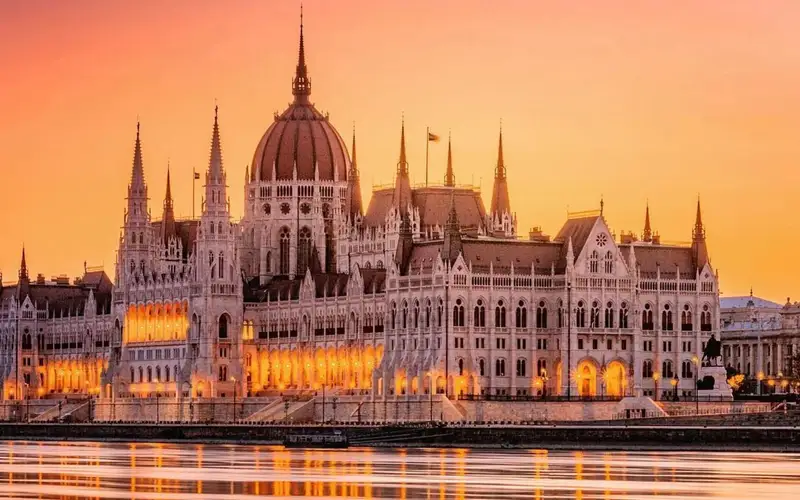
- Day 1, Budapest: arrive, settle into a hotel in Pest, and take a dinner cruise on the Danube past the lit Parliament and the Chain Bridge.
- Day 2, Budapest: a morning in one of the thermal baths, then the ruin bars of the Jewish Quarter with a guide in the evening.
- Day 3, Etyek: a wine day in the hills west of the city, with tastings at family wineries.
- Day 4, Vienna: the train to Vienna with private transfers at both ends, then a highlights tour of the Ringstrasse, the imperial palaces and St. Stephen's Cathedral.
- Day 5, Vienna: a cooking class with lunch, then a free afternoon for a museum or a coffee house.
- Day 6, Prague: the train to Prague, then Prague Castle with a guide, timed around your arrival.
- Day 7, Prague: a Baroque library and Czech beer, or a food tour, and a farewell dinner.
- Day 8: transfer to the airport for your flight home.
With ten days, the extra nights go to Vienna, where Schönbrunn deserves half a day of its own, and to Prague, where we add a day trip to Kutná Hora or Český Krumlov.
Tickets and fares in 2026
Three railways sell this route: ÖBB in Austria, České dráhy in the Czech Republic and MÁV in Hungary. Their cheapest tickets follow the same logic:
- Advance fares are train-specific. ÖBB's Sparschiene and the Czech First Minute Europe fares are valid only on the train you choose, with a limited number per train.
- Sales open up to 180 days ahead. We book as soon as your dates are firm, especially for Friday and Sunday trains.
- Refund rules differ. The basic ÖBB Sparschiene Europe fare cannot be refunded; the Komfort version includes a seat reservation and is refundable free of charge up to 15 days before travel. Czech First Minute tickets can be returned until midnight before the day of travel, minus a €3 fee.
- Seat reservations cost extra on most standard fares, a few euros per seat (from €3 on ÖBB trains within Austria), and they are worth it on busy days.
A rail pass rarely pays off for two train legs. Point-to-point tickets booked early cost less than any pass on this route.
First Class or Business on the Railjet?
Many trains on both legs are Railjets, the red trains of ÖBB and Czech Railways, with three classes:
- Economy: comfortable, with a power socket shared between two seats, wifi and a restaurant car.
- First Class: 2+1 seating with more legroom, your own power socket, and food from the restaurant served at your seat on request.
- Business Class: a supplement on top of a First Class ticket, with leather seats, the most space and a seat reservation included. On Czech Railways Railjets, Business also comes with a refreshment voucher for the Czech part of the trip.
On the Budapest line, Railjets alternate with Hungarian EuroCity trains hour by hour, and Business Class exists only on the Railjets. We book First Class for almost all our travelers: booked early, the difference with Economy is often small, and the calmer car makes a real difference with luggage. Business is worth it on the four-hour Prague leg if you want to work or simply spread out.
Arriving at each station
- Budapest Keleti is the grand 19th-century station on the Pest side, a short taxi ride from the hotels around the Basilica and the river. Some trains also stop at Kelenföld on the Buda side; stay on to Keleti for the center.
- Vienna Hauptbahnhof is a modern station south of the old town, with the U1 subway line to Stephansplatz.
- Prague hlavní nádraží sits at the top of the New Town, within walking distance of Wenceslas Square.
Three countries means three currencies: the forint in Hungary, the euro in Austria and the koruna in the Czech Republic. Cards are accepted almost everywhere, so a little cash for tips is enough. All three countries are in the Schengen area, so there is no routine passport control between them. Austria has notified temporary checks at its borders with Hungary and the Czech Republic until at least March 2027, though, and police may board the train: keep your passport at hand.
Adding a fourth stop
- Český Krumlov: a small Bohemian town with a castle above a bend of the Vltava, best as one night between Vienna and Prague with a private driver.
- The Wachau: the Danube wine valley west of Vienna, with Melk Abbey, as a day trip or one night.
- Salzburg and Munich: continue west from Vienna instead of north. Munich is about four hours from Vienna by direct Railjet; our Munich itinerary explains how to spend your days there.
Traveling with reduced mobility
Railjets have wheelchair spaces, and the main stations provide boarding help with lifts and on-train wheelchairs when you book ahead. For a cross-border trip, ÖBB asks for at least 24 hours' notice through its Mobility Service Center (+43 5 1717 5), and assistance in the Czech Republic and Hungary is arranged with the partner railways, so we register it as early as possible. The old towns are harder than the trains: Prague's Lesser Town and Castle district are steep and cobbled, and Buda's Castle Hill is best reached by car. We plan these days with adapted vehicles and hotels with step-free entrances, as explained in our guide to Europe with limited mobility.
When to go
May, June, September and early October are our favorite months: long days, terraces open, and comfortable weather for walking. July and August are the busiest weeks and can be hot in Budapest. From mid to late November, Christmas markets open in all three cities, with short days and cold evenings, and the trains fill on weekends.
Our Budapest, Vienna and Prague by train itinerary turns this plan into eight days with three 5-star hotels and private transfers at every station. For longer combinations, see our Europe in 14 days routes, and our Europe by train guide covers booking, passes and luggage. More rail itineraries are on our train trips page.
Tell us your dates and one of our travel designers will set the order, book the trains and send a priced custom version of this route within 48 hours.