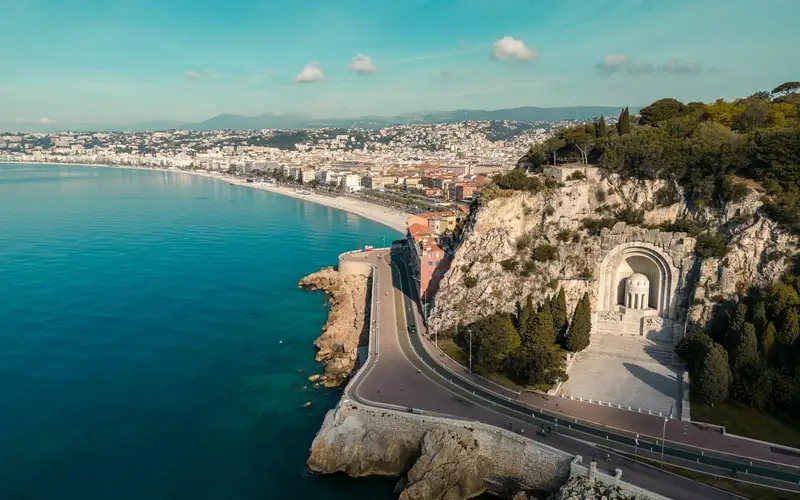
In the countries where we design trips, the most wheelchair accessible cities are Zurich, Berlin, Munich, Lyon and Nice: flat centers, low-floor trams or buses on most routes, and a good stock of hotels with real roll-in showers. Paris and Strasbourg come next, each with one big weakness you can plan around. Venice, Bruges and the hill towns of Italy and Provence are the hardest, however often they appear on "accessible" lists.
Most rankings of accessible European cities are built from awards and tourist-board claims. Ours comes from planning trips for wheelchair users and travelers with limited mobility in France, Switzerland, Germany, Italy and Belgium, and from checking the same five things in every city.
How we judge a city's accessibility
- Terrain. Is the center flat, and how much of it is cobbled? A city can have perfect buses and still be exhausting if the sights sit on a hill.
- Public transport. Can a wheelchair user board trams, buses and trains without help, and does the operator publish lift outages in real time?
- Sights. Do the main museums and monuments have step-free entrances, lifts and accessible toilets, and do they lend wheelchairs?
- Hotels. Are there enough rooms with roll-in showers and wide doors, in central locations, for us to choose among them?
- Adapted vehicles. Can we book ramp or lift vans for transfers and longer days?
What the European Access City Award tells you (and what it does not)
The European Commission's Access City Award recognizes EU cities that have improved accessibility across transport, public spaces, information and services. Among the cities we work in, Berlin won first prize in 2013, Milan in 2016 and Lyon in 2018. Luxembourg won in 2022, Nuremberg took second prize in 2025 and Rennes third prize in 2026, when the first prize went to Zaragoza in Spain.
The award is a good signal of political will, but it judges a city's programs, not what a visitor will meet in the old town. It also covers only EU cities, so Swiss cities never appear, though Zurich and Basel are among the easiest we know.
The most wheelchair accessible cities we plan trips to
Zurich
Zurich is compact, and the center along the Limmat and the lake is mostly flat. Most tram lines run low-floor vehicles, and the main station is step-free, with lifts to every platform and direct trains to the airport. The Swiss rail timetable shows, for each connection, whether you can board on your own. The weak spots are the cobbled lanes of the Niederdorf and the short climb to the Lindenhof. Our guide to wheelchair accessible Switzerland covers the trains, the mountains and SBB's free assistance service.
Berlin
Berlin is flat, wide and modern in most of the areas visitors use. Buses and trams are low-floor, and a large share of U-Bahn and S-Bahn stations have lifts; the transport company publishes their status, which is worth checking each morning. Distances are the challenge: the city is spread out, so we group sights by district and use adapted vans between them. On Museum Island, check which buildings are open, since the Pergamon Museum has been closed for renovation for several years.
Munich
The old town is pedestrianized, flat and paved in large part, and the U-Bahn network was built with lifts as standard in its newer sections. The Christmas markets on Marienplatz and in the pedestrian zone are among the easiest in Germany for a wheelchair, with level squares and wide lanes, though very crowded on weekends. Day trips are harder: Neuschwanstein, for instance, involves a steep approach and many stairs inside.
Lyon
Lyon won the Access City Award in 2018, and it shows on the Presqu'île, the flat peninsula between the Rhône and the Saône where most of the shops, squares and restaurants are. Trams are low-floor and most metro stations have lifts. The old town, Vieux Lyon, is cobbled, and the Croix-Rousse hill is steep; the Fourvière basilica is reached by funicular. We base travelers in the Presqu'île and visit Vieux Lyon with a guide who knows the smoothest route through the traboules that can be visited.
Nice
Nice has a 7 km flat seafront, the Promenade des Anglais, and a tram network that the operator describes as fully accessible, with platforms level with the floor of the tram. Tram line 2 runs to the airport. Most buses have a ramp and a wheelchair space, and more than 800 stops have been rebuilt with raised platforms. The beaches are pebbles, which is why beach wheelchairs matter. The perched villages around Nice are another matter; we cover them in our French Riviera trips.
Paris
Paris has excellent accessible museums and very poor metro access. Only line 14 is accessible at every station; every bus line has a ramp and a wheelchair space. The Louvre, Orsay and Versailles lend wheelchairs and give priority entry. Montmartre and parts of the Marais are steep or cobbled. With an adapted van and a checked hotel, Paris works well; our guide to wheelchair accessible Paris is the full picture.
Strasbourg
The Grande Île, the island at the heart of Strasbourg, is mostly pedestrian and flat, and the tram network is low-floor. At Christmas the city lends wheelchairs and walkers free from the information chalet on Place Kléber and publishes an accessibility map of the markets with level routes and adapted toilets. The crowds on December weekends are the real obstacle; weekday mornings are much easier.
Milan
Milan, the 2016 award winner, is flat, and its newer metro lines were built step-free, while some older stations still lack lifts. The Duomo square and the Galleria are level and wide. We check the specific stations on your routes and use adapted vehicles for the rest.
Cities that are harder than they look
- Venice. Most bridges have steps, which cuts the city into islands for a wheelchair user. The water buses are the way around, and the city publishes barrier-free route maps, but a Venice stay needs a hotel chosen by its position relative to the bridges.
- Bruges and Ghent. Flat, but cobbled almost everywhere, with narrow pavements. Manageable for short visits, tiring over a full day.
- Brussels. The city is split between an upper and a lower town on a steep slope, and the Grand-Place is cobbled.
- Hill towns. Èze, Saint-Paul-de-Vence, Rothenburg ob der Tauber, the villages of Tuscany and the Cinque Terre: these are beautiful, but often steep and stepped. We plan them for the view from an accessible terrace rather than a walk through the lanes.
Quick comparison
| City |
Terrain |
Public transport |
Main watch-out |
| Zurich |
Mostly flat center |
Low-floor trams, step-free main station |
Old town lanes |
| Berlin |
Flat |
Low-floor buses and trams, many lifts |
Long distances |
| Munich |
Flat, pedestrian center |
U-Bahn with lifts |
Weekend crowds |
| Lyon |
Flat peninsula, steep hills |
Low-floor trams, metro lifts |
Vieux Lyon cobbles |
| Nice |
Flat seafront |
Fully accessible tram |
Perched villages, pebble beaches |
| Paris |
Mixed |
Buses and line 14 only |
Metro, old hotels |
| Strasbourg |
Flat island |
Low-floor trams |
December crowds |
| Milan |
Flat |
Newer lines step-free |
Older metro stations |
Outside our area
Vienna, Barcelona and Amsterdam often lead international lists, and Spanish cities took the top two Access City Awards in 2026. We do not design trips there, so we do not rate them; the criteria above will help you judge them yourself. For an overview of the continent, read our guide to accessible travel in Europe.
Turning an accessible city into an accessible trip
A good city is only the start. The trip works when the hotel bathroom has been checked, the train assistance is booked, the van is waiting at the station and the days have two main visits rather than five. That is what Caroline does for every itinerary on our accessible trips page. Two ready-made starting points: Accessible Paris in 7 Days, from EUR 1,699 (about $1,970) per person, and Accessible French Riviera in 8 Days, from EUR 1,499 (about $1,740), both with adapted transfers and a checked hotel. You can also browse every country we cover from our Europe page.
Tell us which cities you have in mind and how you move, and a designer will tell you honestly which ones will work and send you a custom version of the trip.