Most German Christmas markets in 2026 open between November 16 and November 27 and close on December 22, 23 or 24. Cologne's cathedral market opens first (November 16), Munich follows on November 20, Dresden on November 25 and Nuremberg on November 27. The best way to see them is by train, two or three nights per city, on weekdays between November 30 and December 18, when every market is open and the weekend crowds are elsewhere.
Our travel designer Lucie lived and worked in Germany and designs our German itineraries. Below are the 2026 dates and hours we confirmed on each city's official site, what makes each market different, and the train routes we use to string three or four of them together.
German Christmas market dates for 2026
| Market |
City |
2026 dates |
Daily hours |
Known for |
| Christkindlesmarkt |
Nuremberg |
Nov 27 to Dec 24 |
10 am to 9 pm (Dec 24 until 2 pm) |
the Christkind's opening, Lebkuchen |
| Christkindlmarkt |
Munich |
Nov 20 to Dec 24, closed Nov 22 |
10 am to 9 pm, Sun until 8 pm (Dec 24 until 2 pm) |
Marienplatz below the Town Hall |
| Striezelmarkt |
Dresden |
Nov 25 to Dec 24 |
10 am to 9 pm (Dec 24 until 2 pm) |
held since 1434, Stollen |
| Cathedral market |
Cologne |
Nov 16 to Dec 23, closed Nov 22 |
11 am to 9 pm, Thu and Fri until 10 pm, Sat 10 am to 10 pm |
stalls beneath the cathedral |
| Heinzels Wintermärchen |
Cologne |
Nov 23 to Dec 23 (Heumarkt until Jan 10, 2027) |
from 11 am |
old-town squares, ice rink |
| Reiterlesmarkt |
Rothenburg ob der Tauber |
Nov 20 to Dec 23, closed Nov 22 |
11 am to 7 pm, Fri and Sat until 8 pm |
a walled medieval town |
| Weihnachtsmarkt |
Stuttgart |
Nov 25 to Dec 23 |
11 am to 9 pm, Fri and Sat until 10 pm (Nov 25 from 5 pm) |
lovingly decorated stalls |
| Weihnachtsmarkt |
Aachen |
Nov 20 to Dec 23 |
11 am to 9 pm (Nov 22 from 6 pm) |
around the cathedral and town hall |
| Weihnachtsmarkt |
Heidelberg |
Nov 23 to Dec 22 |
11 am to 9 pm Sun and Mon, Sat until 10 pm (check other days) |
ice rink below the castle |
| Römerberg market |
Frankfurt |
Nov 23 to Dec 22 |
10 am to 9 pm, Sun from 11 am |
Bethmännchen, hot apple wine |
| WeihnachtsZauber |
Berlin, Gendarmenmarkt |
Nov 23 to Dec 31 |
11 am to 10 pm, Fri and Sat until 11 pm |
open until New Year's Eve |
Three practical notes. Sunday November 22, 2026 is Totensonntag, a day of remembrance, and Munich, Cologne's cathedral market and Rothenburg stay closed that day. Almost every market ends on December 22, 23 or 24, and most of those open on December 24 close in the early afternoon. If your trip runs past Christmas, Berlin is the city to end in: the Gendarmenmarkt runs to December 31 and the Charlottenburg Palace market to December 27.
Nuremberg: the one everybody knows
Nuremberg's Christkindlesmarkt fills the Hauptmarkt from November 27 to December 24, 2026. It opens on Friday, November 27 at 5:30 pm, when the Christkind, the figure in gold and white who opens the market each year, reads the prologue from the balcony of the Frauenkirche. It is one of the moments of the German Advent, and the square is full an hour before.
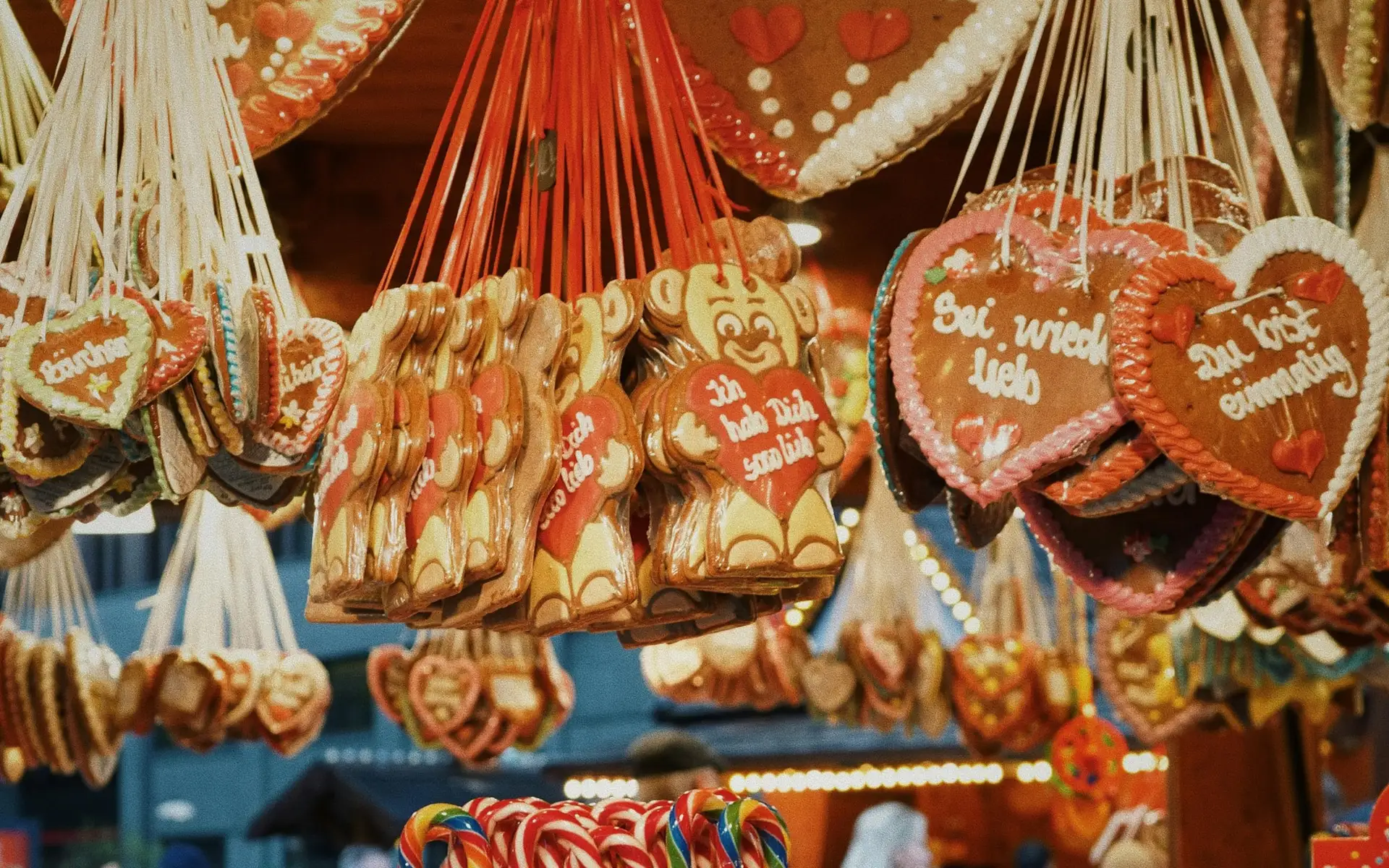
What to taste: Nürnberger Lebkuchen (gingerbread, sold in tins that travel well), Rostbratwurst served three in a roll, called "Drei im Weggla", and the dried-prune figures called Zwetschgenmännle.
Our advice: Friday and Saturday evenings are packed. Go on a weekday morning when the stalls open at 10 am, then come back at dusk. Hotels inside the city walls fill first for December weekends, so we hold rooms as soon as your dates are set. Nuremberg also deserves a day without the market: the castle, the old town and the history of the trials at the Palace of Justice.
Munich: Marienplatz and a day in Salzburg
Munich's city market opens on Friday, November 20, 2026, for the first time on the Friday before Totensonntag, earlier than in past years, and runs to December 24 with about 140 stalls around Marienplatz and the neighboring streets. The tree is lit for the first time at 5 pm on opening day, and on Sunday, December 13 the Krampus run, with men in fur and horned masks, crosses the market in the afternoon. Look for the Kripperlmarkt, the section of stalls selling nativity figures and crib scenery.
Munich is also our base for a day in Austria. Direct trains reach Salzburg in about 1 hour 30 to 1 hour 45 minutes, and Salzburg's own market, in front of the cathedral, runs from November 19, 2026 to January 1, 2027. If you want Neuschwanstein too, read our Neuschwanstein day trip from Munich before you plan the day, as winter changes the logistics. Heading south instead, Bolzano is about 4 hours from Munich over the Brenner Pass, and its market runs to January 6; see our guide to Christmas markets in Italy.
Dresden: the oldest
The Striezelmarkt on the Altmarkt reaches its 592nd edition in 2026: it has been held since 1434, which makes it one of the oldest documented Christmas markets in Germany. It runs from November 25 to December 24, 2026, and opens at 4:30 pm on November 25. Its name comes from Striezel, the old word for Dresdner Christstollen, and the Stollen festival takes place on Saturday, December 5, 2026.
Dresden has smaller markets elsewhere in the old town, all within walking distance of the Altmarkt. Bring home wooden figures and smoking men from the Erzgebirge mountains, carved in the region south of the city.
Cologne and Aachen: the Rhineland markets
Cologne has several large markets, and the one beneath the cathedral on Roncalliplatz is the most photographed: November 16 to December 23, 2026, more than 120 stalls, closed on November 22. Heinzels Wintermärchen, on the Alter Markt and the Heumarkt in the old town, opens on November 23, and the Heumarkt part, with an ice rink around the equestrian statue, stays open until January 10, 2027 (closed December 24 and 25).
Aachen runs its market around the cathedral and the town hall from November 20 to December 23, 2026. It is the city of Printen, the spiced biscuit the tourist office calls Aachen's national cookie. Both cities sit on the high-speed line from Brussels, which reaches Cologne in about 1 hour 50 minutes, so the Rhineland is the natural first stop for travelers flying into Brussels or combining Belgium and Germany.
Rothenburg and Heidelberg: the small towns
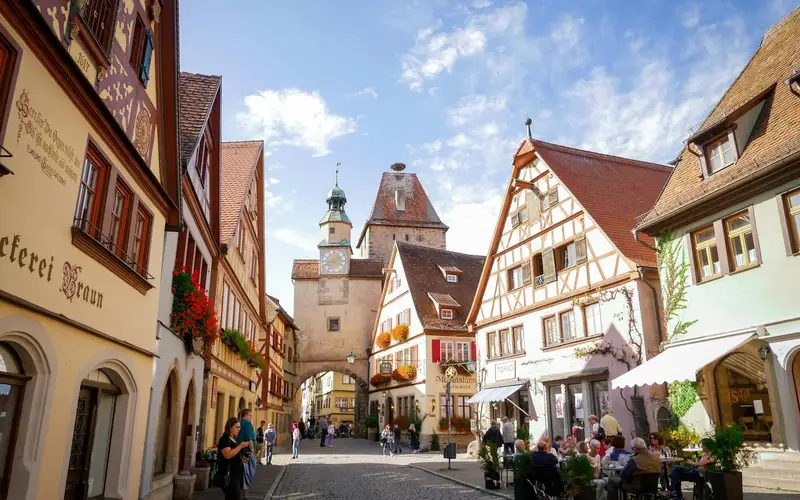
Rothenburg ob der Tauber holds its Reiterlesmarkt from November 20 to December 23, 2026 on the Marktplatz and the squares around it, with a second opening ceremony for the Reiterle figure on Friday, November 27 at 5 pm. Entry is free. The town is small and empties when the day visitors leave, so we suggest one night inside the walls rather than a rushed day trip. By rail it is a regional line with a change in Steinach; on our Germany trip we include it in a private day out from Munich instead, with Harburg Castle on the way.
Heidelberg opens its market on November 23, 2026 on the Marktplatz, until December 22, with an ice rink on the Karlsplatz below the castle into early January. It is an easy stop on a Rhine route between Frankfurt and Stuttgart.
Stuttgart, Frankfurt and Berlin
- Stuttgart: November 25 to December 23, 2026, with more than 200 stalls in the old town. The market is known for the care stallholders put into decorating their stalls, and a Ferris wheel turns on the Schlossplatz until January 6, 2027.
- Frankfurt: the Römerberg market runs from November 23 to December 22, 2026, with more than 230 stalls between the half-timbered Römer and the cathedral. Taste Bethmännchen (marzipan cookies) and hot apple wine. A direct train reaches Strasbourg in about 1 hour 50 minutes, which makes Frankfurt a hinge between Germany and Alsace; our guide to Christmas markets in France takes over from there.
- Berlin: the WeihnachtsZauber on the Gendarmenmarkt, between the two domed churches and the concert hall, runs from November 23 to December 31, 2026. It charges EUR 2 (about $2.30) admission, free on weekdays from 11 am to 2 pm except December 24 to 26 and 31. Charlottenburg Palace has a quieter market from November 23 to December 27.
How to combine German Christmas markets by train
Germany's ICE network links the big market cities in about one to three hours. The legs we use most:
| Route |
Fastest train, about |
| Munich to Nuremberg |
1 hour 5 minutes (ICE) |
| Munich to Salzburg |
1 hour 30 to 1 hour 45 minutes (railjet or EuroCity) |
| Nuremberg to Dresden |
3 hours 10 minutes, one change |
| Dresden to Berlin |
1 hour 35 minutes |
| Brussels to Cologne |
1 hour 50 minutes |
| Cologne to Frankfurt |
1 hour 10 minutes (ICE) |
| Frankfurt to Strasbourg |
1 hour 50 minutes, direct |
Until December 12, 2026, works between Ingolstadt and Nuremberg add about 30 minutes to many Munich to Nuremberg trains, and some ICEs start in Nuremberg instead of Munich, so the fastest trip is about 1 hour 40 minutes until then. We check the exact timetable when we book.
Three routes we design:
- Bavaria to Berlin, 9 days: Munich with a day in Salzburg, Rothenburg and Harburg, Nuremberg, Dresden and Berlin, eight nights in 4-star old-town hotels, first-class trains with seat reservations. This is our Germany Christmas Markets by Train trip, from EUR 2,299 (about $2,670) per person, and the most direct answer to a first German Christmas.
- The Rhineland and Alsace, 8 to 10 days: Cologne with a half day in Aachen, Frankfurt or Heidelberg, then across the border to Strasbourg and Colmar.
- Bavaria in a week: Munich and Nuremberg as two bases, with day trips to Salzburg and Rothenburg. Good for a shorter trip or a first visit to Europe; see our ideas for Germany in 10 days if you have longer.
Tickets: a first-class Flexpreis ticket on Deutsche Bahn includes a seat reservation and access to DB Lounges; with a saver fare, a reservation costs EUR 6.90 in first class and EUR 5.50 (about $6.40) in second, and we always add one in December, when trains are full of market visitors. Deutsche Bahn sets no weight limit on luggage, but you must be able to lift your own bags onto the racks. Our Christmas markets by train guide covers first class, luggage and reservations across Europe in detail.
Where we base our travelers
We stay inside the old towns, a short walk from the main market, because the markets are at their best after dark and you will want to go back after dinner without a taxi. In practice: near Marienplatz in Munich, inside the walls near the Hauptmarkt in Nuremberg, around the Neumarkt in Dresden, near the cathedral in Cologne, in Mitte for Berlin, and inside the walls in Rothenburg. We plan two or three nights per base, never one, so that you see each market both by day and lit up.
Crowds and weekday tips
- Avoid the opening weekends (November 27 to 29 in Nuremberg) and the Saturdays of December unless you like a crowd.
- Go at opening time (10 or 11 am) for photos and shopping, and come back after dark for the atmosphere.
- Keep Sunday November 22 for travel: several markets are closed for Totensonntag.
- Mugs carry a deposit, called Pfand. Return the mug for your coins, or keep it as a souvenir. Bring some cash, as smaller stalls may not take cards.
- Book early for weekends: old-town hotels in Nuremberg and Dresden fill first. Weekday nights in the first half of December stay available longer.
If you are still choosing between Germany, Alsace and Switzerland, our selection of the best Christmas markets in Europe compares the top ten across borders.
Christmas markets with reduced mobility
The main squares in Munich, Dresden and Cologne are flat, but most old towns are paved with cobblestones and the aisles between stalls get crowded after dark. Rothenburg and the castle side of Nuremberg are hilly. Deutsche Bahn's Mobility Service Center arranges free help with boarding at stations when booked ahead, and we request it at least a day before each journey. We choose hotels a short, step-free walk from the market and plan visits at opening time on weekdays, when you can move between the stalls easily.
Tell us which markets you want to see and when you can travel, and Lucie or another of our travel designers will build your German Christmas route, reserve the trains and hold the hotels by the squares.