Europe's best Christmas markets are all on the rail network, and the train is the easiest way to see them: the stations are in the city centers, the old towns are closed to cars during the markets, and you never drive on winter roads. The routes that work best are Bavaria to Berlin, the Rhine from Cologne to Alsace, Alsace and Switzerland, Munich to Vienna, and Belgium with the Rhineland. Plan two or three nights per city, travel in first class with a seat reservation, and go on weekdays between November 30 and December 18, 2026, when every market is open.
We design Christmas market trips by train every winter, mostly for travelers from North America. Here are the five itineraries we use, with the 2026 market dates we confirmed, the journey times, and what we have learned about first class, luggage and reservations in December.
Why the train works for Christmas markets
- Stations are central. In Strasbourg, Colmar, Nuremberg, Munich, Cologne and Basel, the market is a short walk or tram ride from the station.
- Old towns are closed to traffic. Strasbourg bans cars from the Grande Île while its market is open, and Colmar closes its center to all vehicles during market hours from November 23 to December 29, 2026. A car is a problem, not a help.
- The markets are best at night. You want to be in a hotel in the old town after dark, not driving back to it on icy roads.
- The distances are short. Most legs on our routes take between 30 minutes and two hours, so you spend the day at the markets, not on the train.
The five best Christmas market routes by train
| Route |
Markets |
Days |
Longest leg, about |
| Bavaria to Berlin |
Munich, Salzburg, Nuremberg, Dresden, Berlin |
9 |
3 hours 10 minutes (Nuremberg to Dresden) |
| The Rhine |
Cologne, Aachen, Frankfurt, Strasbourg, Colmar |
8 to 10 |
1 hour 50 minutes (Frankfurt to Strasbourg) |
| Alsace and Switzerland |
Strasbourg, Colmar, Basel, Lucerne or Zurich, Montreux |
7 to 10 |
about 2 hours 30 minutes (Basel to Montreux) |
| Munich to Vienna |
Munich, Salzburg, Vienna |
6 to 8 |
2 hours 30 minutes (Salzburg to Vienna) |
| Belgium and the Rhineland |
Brussels, Bruges, Cologne, Aachen |
6 to 8 |
1 hour 50 minutes (Brussels to Cologne) |
1. Bavaria to Berlin: the classic German route
Munich (November 20 to December 24, 2026), with a day in Salzburg, then Nuremberg (November 27 to December 24), Dresden (November 25 to December 24) and Berlin, where the Gendarmenmarkt stays open until December 31. Munich to Nuremberg is about 1 hour 5 minutes by ICE (about 1 hour 40 minutes until December 12, 2026, while works slow the line) and Dresden to Berlin about 1 hour 35 minutes. Nuremberg to Dresden is the long day, about 3 hours 10 minutes at best with a change, so we schedule it mid-morning.
This is our Germany Christmas Markets by Train trip: eight nights in 4-star hotels inside the old towns, first-class trains with seat reservations, guided market tours in Munich and Nuremberg, and a day in Rothenburg ob der Tauber, from EUR 2,299 (about $2,670) per person. For every market's dates and hours, see our guide to German Christmas markets.
2. The Rhine by rail: Cologne to Colmar
The train version of a Rhine cruise, with nights in the old towns instead of on a ship. Start in Cologne, whose cathedral market runs from November 16 to December 23, 2026, with a half day in Aachen (November 20 to December 23). Cologne to Frankfurt is about 1 hour 10 minutes by ICE, and Frankfurt's Römerberg market runs from November 23 to December 22. A direct train takes about 1 hour 50 minutes from Frankfurt to Strasbourg (November 27 to December 24), and Colmar (November 23 to December 29) is another 26 minutes by regional train. Heidelberg, with its market from November 23 to December 22, is an easy extra night between Frankfurt and Strasbourg.
3. Alsace and Switzerland
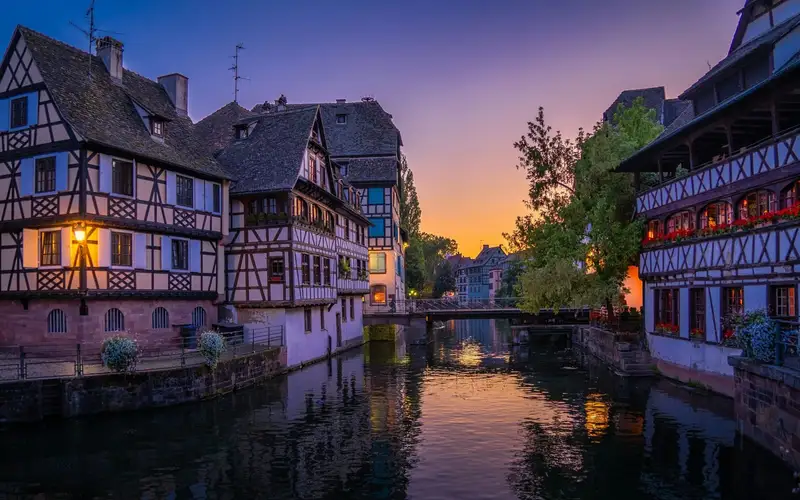
Two nights in Strasbourg, two or three in Colmar with a driver for the wine villages, then Basel, about 45 minutes from Colmar. Basel's market, on Barfüsserplatz and Münsterplatz, runs from November 26 to December 23, 2026, daily from 11 am to 8:30 pm. From Basel, Lucerne is about an hour and Zurich 53 minutes, and Montreux Noël, on the shore of Lake Geneva, runs from November 20 to December 24 with more than 150 chalets. Swiss trains need no reservation on ordinary routes, and the timetable makes this the most relaxed of the five routes.
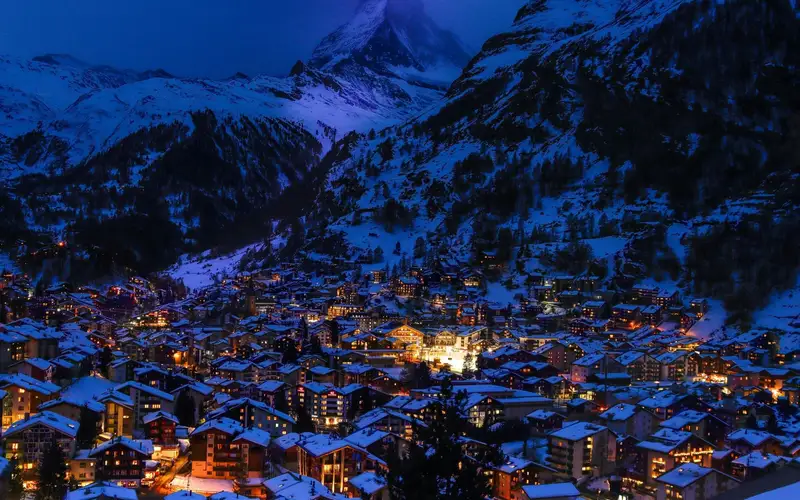
Our Belgium, Alsace and Switzerland by Train trip follows this line from Brussels to Strasbourg, Colmar, Basel and Zermatt, and our guide to Christmas markets in Switzerland has the Swiss dates.
4. Munich, Salzburg and Vienna
Munich to Salzburg takes about 1 hour 30 to 1 hour 45 minutes by direct railjet or EuroCity, and Salzburg to Vienna about 2 hours 30 minutes. Salzburg's Christkindlmarkt, on the cathedral and Residenz squares, runs from November 19, 2026 to January 1, 2027, with a Krampus run on December 5. Vienna opens earliest of all: the Rathausplatz market from November 13 to December 26, and the Schönbrunn Palace market from November 6, 2026 to January 6, 2027. This route works well for travelers who want to spend Christmas itself in Europe, since Vienna and Salzburg keep their markets open after December 24. If you start in Switzerland, the EuroCity from Zurich reaches Munich in about 3 hours 30 minutes. Munich is also the start of the Brenner line to Bolzano, about 4 hours south, whose market runs until January 6; our guide to Christmas markets in Italy has the 2026 dates.
5. Belgium and the Rhineland
Brussels runs Winter Wonders from November 27, 2026 to January 3, 2027, with 238 chalets around the old town, including Place Sainte-Catherine. Bruges, about an hour away by direct train, has its Winter Glow from November 20, 2026 to January 31, 2027, with a covered ice rink in King Albert I Park. From Brussels, the high-speed train reaches Cologne in about 1 hour 50 minutes, stopping in Aachen. Paris to Brussels takes about 1 hour 22 minutes, so this route also starts well from Paris.
And France: Paris to Strasbourg is about 1 hour 45 minutes by TGV, and a direct train links Strasbourg to Lyon in about 3 hours 45 minutes, in time for the Festival of Lights from December 5 to 8, 2026. Our guide to Christmas markets in France has all the French dates, and French Christmas in 7 Days combines Colmar, Lyon and three nights of skiing in Val d'Isère.
First class on a Christmas market trip
We book first class on every long-distance leg in December, and it is not only about comfort. Trains between market cities are full of day visitors on weekends, and first class gives you a calmer car, a reserved seat and room near your luggage.
- Germany (Deutsche Bahn): a first-class Flexpreis ticket includes a seat reservation and access to DB Lounges in the main stations. Saver fares do not, and are valid only on the train booked.
- Austria (ÖBB railjet): First class has 2+1 seating with at-seat service; Business class, sold as a supplement, adds leather seats and a reserved seat.
- France (TGV INOUI): every TGV ticket includes an assigned seat; first class has wider seats in a 2+1 layout on most trains.
- Switzerland (SBB): no reservation is needed on ordinary trains; first class is quieter on weekend trains around Basel and Zurich.
Luggage on European trains
| Operator |
Rule in 2026 |
| Deutsche Bahn |
No weight limit; hand luggage plus one larger bag you can lift yourself |
| SNCF (TGV, Intercités) |
Two suitcases (up to 70 x 90 x 50 cm) and one small bag, each labeled; fines from EUR 50 for extra bags |
| Eurostar |
Two suitcases and one hand item, no weight limit |
| SBB |
No set limit; take only what you can carry and keep the aisles clear |
In practice, one medium suitcase per person is the rule we give our travelers. Christmas shopping adds weight as the trip goes on, so we arrange private transfers between hotels and stations, and use luggage services where they exist. Coats and boots take space: pack layers rather than bulk.
Reservations, tickets and winter delays
- Reserve your seats. On German trains a reservation costs EUR 5.50 (about $6.40) in second class or EUR 6.90 in first if your fare does not include one. In December, trains to Nuremberg, Munich and Cologne fill up, and an unreserved seat is a gamble.
- Book flexible fares for long legs. A saver fare ties you to one train. With winter weather, a Flexpreis ticket lets you take the next train if a connection is missed.
- Leave a buffer. Snow and ice can delay trains, rarely cancel them. We avoid tight connections and leave a comfortable margin between the last train and your flight home.
- Mind Totensonntag. On Sunday, November 22, 2026, several German markets are closed, which makes it a good travel day.
Train or river cruise?
A river cruise lets you unpack once; a train trip lets you sleep in the old towns, see the markets lit up every evening and reach the ones no ship reaches, such as Munich, Dresden, Colmar or Montreux. We compare both honestly, including cost, in Christmas markets by train or river cruise.
When to go in 2026
- November 20 to 26: Munich, Cologne, Montreux, Salzburg and Vienna are open; Strasbourg and Nuremberg are not yet.
- November 27 to 29: opening weekend in Strasbourg, Nuremberg and Brussels. Festive and crowded.
- November 30 to December 18, weekdays: the best window. Everything is open, and the trains are calmer.
- December 5 to 8: the Festival of Lights in Lyon.
- After December 24: Colmar (to December 29), Berlin's Gendarmenmarkt (to December 31), Vienna, Salzburg, Brussels and Bruges keep going.
Christmas markets by train with reduced mobility
Every operator on these routes offers free assistance at stations, as long as you book it ahead: Deutsche Bahn through its Mobility Service Center, SNCF through Assist'enGare at least 24 hours before departure, SNCB in Belgium at least 24 hours ahead in most cases (longer for international journeys), and SBB at least an hour ahead within Switzerland and 24 hours for international trips. We book it with your tickets. At the markets, the squares are mostly flat but cobbled and crowded after dark, so we choose hotels a short, step-free walk away and plan visits at opening time on weekdays.
See all our ideas on the Christmas markets trips page, then tell us which markets you want to see and when, and Aurélie will design your route by train, with the seats reserved and the hotels by the squares.