A Beaujolais wine tour starts 30 minutes north of Lyon, and it is the wine region we know best: our office is in Villefranche-sur-Saône, its main town. One day with a driver covers the golden-stone villages of the south and two or three of the ten crus in the north. Sleep one or two nights in the vineyards if you want to taste the crus properly, or if you come for Beaujolais Nouveau, released on the third Thursday of November (November 19, 2026).
Abroad, the Beaujolais is better known for its Nouveau than for its crus, which is a pity. The region makes serious, often age-worthy reds from the Gamay grape, sold at prices that still surprise visitors who have just been to Burgundy.
The Beaujolais in brief: south and north
|
South: the Pierres Dorées |
North: the crus |
| Landscape |
Rolling hills, golden limestone villages, small castles |
Steeper slopes of granite and schist, villages named after their wine |
| Main appellations |
Beaujolais (red, rosé and white) |
The ten crus and Beaujolais-Villages |
| Villages to see |
Oingt, Theizé, Châtillon-d'Azergues, Bagnols |
Fleurie, Juliénas, Villié-Morgon, Chiroubles, Romanèche-Thorins |
| From Lyon by car |
about 30 to 45 minutes |
about 45 minutes to 1 hour 15 |
| Best for |
Village walks, long lunches, architecture |
Tasting the region's finest wines |
Twelve appellations, one grape
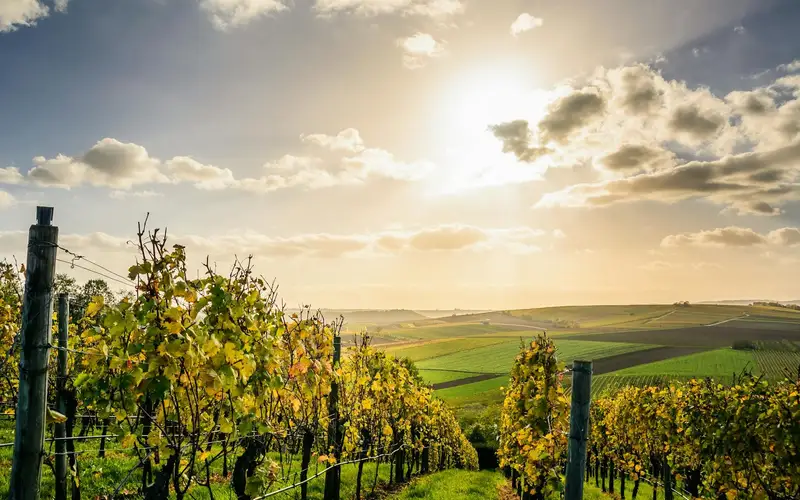
The vineyard covers about 13,500 hectares (33,000 acres), and about 97% of it is planted with Gamay. Chardonnay is the only white grape allowed, for the small production of Beaujolais blanc. The wines are sold under 12 appellations:
- Beaujolais, mostly from the south;
- Beaujolais-Villages, from 38 villages in the north and center;
- ten crus, each named after its village or hill.
Beaujolais Nouveau is made only under the first two appellations, never under the crus. The Beaujolais is often filed under Burgundy in wine books, and its northern tip touches the Mâconnais, but it has its own grape, its own appellations and its own character. Our guide to a Burgundy wine tour from Lyon explains how to add Beaune and the Côte d'Or.
The ten crus, from north to south
| Cru |
What to know |
Style in the glass |
| Saint-Amour |
The northernmost cru, on the edge of the Mâconnais |
Supple and fruity |
| Juliénas |
A wine village with old cellars and steep slopes |
Firm, with spice |
| Chénas |
The smallest cru, rarely seen abroad |
Structured, quiet |
| Moulin-à-Vent |
Named after the old windmill above Romanèche-Thorins |
The most built to age, often compared with Burgundy |
| Fleurie |
The Madone chapel watches over the village |
Floral, silky |
| Chiroubles |
The highest vineyards of the crus, up to about 600 m |
Light and fresh |
| Morgon |
A large cru around the Côte du Py hill |
Deep, ages well |
| Régnié |
The most recent cru, recognized in 1988 |
Bright, red fruit |
| Brouilly |
The largest cru, around the foot of Mont Brouilly |
Generous, easy to love |
| Côte de Brouilly |
The slopes of Mont Brouilly, on hard blue stone |
More mineral and tense than Brouilly |
When we plan tastings, we pick two or three crus that contrast, for example Fleurie, Morgon and Moulin-à-Vent, rather than trying to see all ten in one day.
The Pierres Dorées: the golden-stone villages
South of Villefranche, the villages are built from a local limestone tinted by iron oxide, which turns honey-gold in the late afternoon sun. The whole Beaujolais has been a UNESCO Global Geopark since 2018, and nowhere is the link between rock, buildings and wine easier to see than here.
- Oingt, a medieval hilltop village above the Azergues valley, is the only village in the Rhône department listed among the Plus Beaux Villages de France. Walk up to the tower and the church for the view.
- Theizé and Châtillon-d'Azergues have castles and chapels in the same golden stone.
- Bagnols is home to the Château de Bagnols, a 13th-century castle that is now a hotel, a good example of the region's top end.
The wines here are mostly Beaujolais red, with rosé and the rarer white, and a glass on a terrace in Oingt is a fine way to end a morning walk.
Our usual day trip from Lyon
| Time |
Plan |
| 9:30 a.m. |
Pick-up at your hotel in Lyon |
| 10:15 a.m. |
Oingt: the lanes and the view before the lunch crowds |
| 11:30 a.m. |
First tasting at a family estate in the Pierres Dorées |
| 1:00 p.m. |
Lunch in a village restaurant |
| 3:00 p.m. |
North to the crus: tastings in Fleurie or Morgon |
| 5:00 p.m. |
The chapel on Mont Brouilly for the view over the vineyards and the Saône valley |
| 6:15 p.m. |
Back in Lyon |
Why we book a driver. Tasting and driving do not mix, and the legal limit in France is 0.5 grams of alcohol per liter of blood, stricter than the 0.08% limit in most of the US. The roads between the crus are narrow and unmarked in places, and a driver who knows them also knows which estate has someone free to receive you.
Without a car. TER trains link Lyon Part-Dieu to Villefranche-sur-Saône in about 25 minutes, up to every half hour. That gets you to the region's main town, not to the estates. The Hameau Duboeuf, a wine park and museum at Romanèche-Thorins, has its own train stop, but for anything else you need a car or a driver.
If you are coming from Paris, our guide to Paris to Lyon by train covers the TGV, and Villefranche is a short regional train beyond Lyon.
Two days or more: sleeping in the vineyards
A night in the Beaujolais changes the trip: you taste at the end of the afternoon when winemakers have time, and you wake up in the vines.
- Villefranche-sur-Saône, the economic capital, has a long main street lined with Renaissance courtyards behind its facades.
- Beaujeu, the historic capital that gave the region its name, hosts the Maison du Terroir Beaujolais and Les Sarmentelles, the best-known Beaujolais Nouveau festival.
- The Hameau Duboeuf at Romanèche-Thorins presents the vine and wine through a museum, gardens and tastings. In 2026 it opened Wednesday to Sunday and closed on Mondays and Tuesdays; check before you go.
- Burgundy is next door. From the northern crus, the Mâconnais starts within minutes, and Beaune is a little over an hour away by road, which makes a Beaujolais and Burgundy trip of three or four nights easy to build.
Many of our travelers prefer to stay in Lyon and go out to the vineyards for the day. That works well, and our answer to is Lyon worth visiting explains how we split time between the city and the vines.
How tastings work in the Beaujolais
- Most estates are family-run, and the person pouring is often the person who made the wine. Visits are by appointment; we book every one.
- Several cru villages have a communal tasting cellar, a caveau, where you can taste wines from many producers in one stop. It is useful when time is short.
- Three estates a day is our limit. After that, the wines blur together. Spitting is normal and expected, even for visitors.
- Buying wine. Estates sell at the cellar door. US customs lets you bring wine home in checked luggage, with duty beyond the personal allowance; we tell you which estates can ship.
- Eat with it. Back in Lyon, the bouchons serve Beaujolais in the pot, the thick-bottomed 46 cl bottle, with saucisson brioché and quenelles.
Beaujolais Nouveau and the wine calendar
- Beaujolais Nouveau: released on the third Thursday of November since 1985, on Thursday, November 19, 2026, and November 18, 2027. The celebrations start at midnight on the Wednesday. In Beaujeu, Les Sarmentelles festival runs from November 18 to 22, 2026, with the midnight release, fireworks and tastings of the new vintage. Our guide to France in November puts the release night into a wider trip.
- Harvest: usually September, sometimes from late August in warm years. Since 1857, winegrowers have climbed to the chapel of Notre-Dame-aux-Raisins on Mont Brouilly every September 8 to ask for a good harvest. During picking, winemakers have little time for visitors, so we book fewer tastings.
- Spring and early summer: green vines, calm estates and long lunches outdoors. April to June is our favorite time to taste.
- Winter: quiet and gray, with some estates closed for holidays, but the cellars are warm and the winemakers have time.
The Beaujolais with reduced mobility
Many cellars are down steep steps or in vaulted basements, and Oingt is a cobbled hilltop with steep lanes. The Mont Brouilly chapel is reached by road. For travelers who use a wheelchair, we choose estates with a ground-floor tasting room and level access, which we check beforehand, and we plan the village walks in Villefranche and the flatter centers.
The Beaujolais anchors many of our food and wine trips, and our French Christmas in 7 Days, from €2,099 (about $2,400) per person, already includes a night in Lyon. Tell us which wines you like and how much time you have, and we will plan your Beaujolais days around the right estates.